


Peptide Synthesis and Common Impurities
Peptide Science
Peptide Synthesis and Common Impurities
How a peptide is assembled, why closely related products can arise, and how purification and testing help explain the final material.
A laboratory reference. No dosing or administration guidance.
A vial of dry peptide powder gives very little away. The intended molecule and a closely related synthesis product may look much the same to the eye. The distinction becomes visible through analytical evidence: what was made, what was separated, and what the final sample contains.
This is why a purity result belongs to the finished material, rather than to the idea of synthesis itself. Building a peptide, purifying it and characterising it are connected stages, but they answer different questions. Following that sequence makes the chemistry behind a certificate of analysis easier to understand.
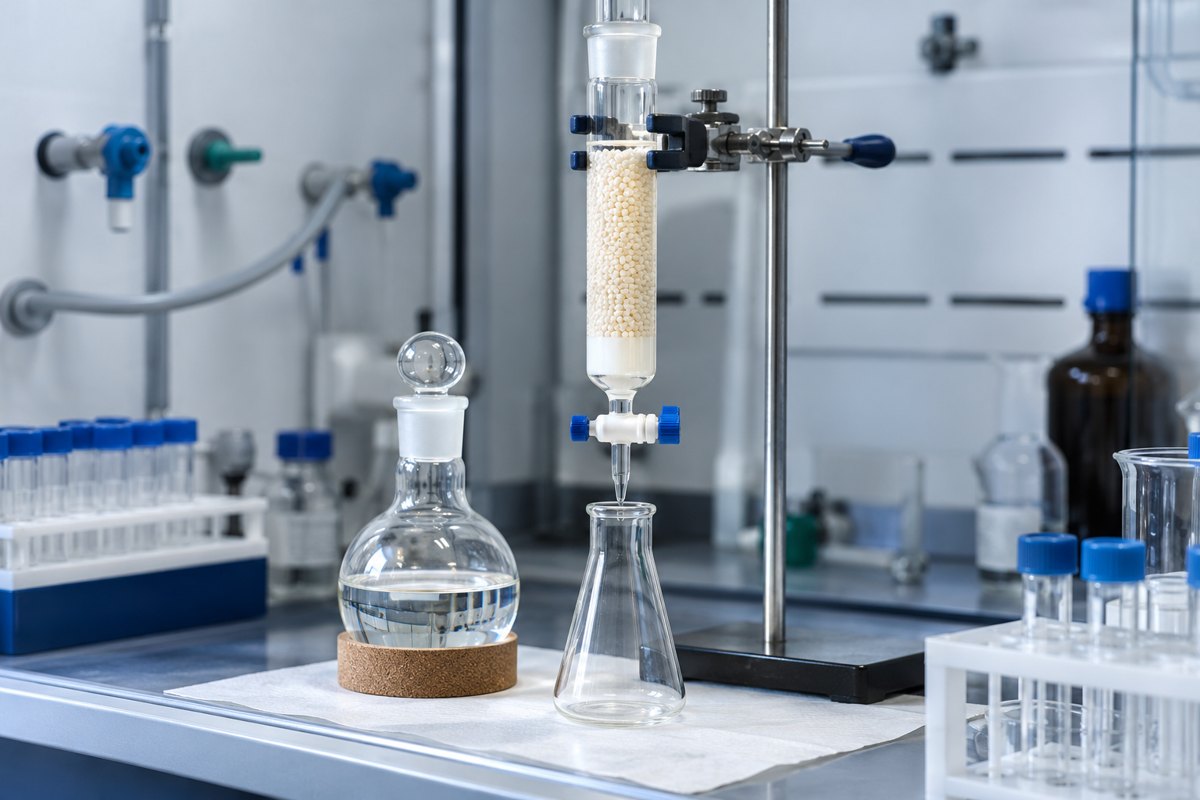
Building a chain, one addition at a time
A peptide has an ordered molecular structure. In solid-phase peptide synthesis, the growing chain is attached to a support while protected amino-acid units are added stepwise. Merrifield’s original 1963 paper demonstrated the concept using a tetrapeptide. The chain was retained on its support during assembly and released afterwards. Merrifield’s original solid-phase synthesis paper.
That arrangement makes stepwise construction possible, but the intended structure is still a chemical objective to establish. The manufacturing description tells us how assembly was approached. The evidence for the resulting material comes later, through its analysis.
A helpful way to picture the process is as a target chain accompanied by possible alternative products. Some alternatives are easy to distinguish from the target; others are close relatives. The final material therefore needs more than a statement that a recognised synthesis technique was used.
Why an efficient step is not the whole story
The example explains a useful distinction without requiring a synthesis recipe: a process can be efficient at each stage and still produce a mixture needing purification. Conversely, a purified sample can be substantially different from the crude mixture that preceded it. Those two samples should not be described as though they were the same material.
Why related sequences can require separation
Illustrative residue symbols only. These are not actual sequences, reported impurities or synthesis instructions.
Closely related products tell different chemical stories
The word “impurity” can conceal important differences. A shortened chain, a substituted residue and an altered linkage are not the same structural problem. In a 2026 primary study, Streuli and colleagues used a defined peptide impurity library to investigate separation and method transfer. The library included deletion sequences, misincorporation, deamidation and isoaspartate-related structures. Streuli et al., analysis and transferability in peptide purification.
| Difference | What changes? | Why the description matters |
|---|---|---|
| Deletion | A residue is missing from the chain. | The related product is shorter than the intended sequence. |
| Misincorporation | A different residue occupies a position. | A similar-looking chain has a different composition. |
| Chemical change or alternative linkage | The structure changes without simply shortening the chain. | The distinction may require attention to structural evidence. |
The examples explain terminology, rather than identify impurities in any PhD Peptides batch. They also show why “other peaks” is only the beginning of an analytical description. Understanding what a related species is can be as important as knowing that it was detected.
The process and the sequence both matter
Changing a process can change the pattern of related products. Collins and colleagues compared solid-phase processes and observed differences involving deletion and insertion products. Their results illustrate why a process change needs comparison of the resulting material, rather than an assumption that its composition remains unchanged. Collins et al., a primary process-comparison study.
Some problems are more specific to the structure being made. A 2024 study investigated aspartimide formation in Asp-based cyclic peptides and a strategy to prevent it in the systems tested. This is a useful example of sequence and structural context shaping the chemistry. It is not a finding about an unrelated commercial product. Li et al., investigation of aspartimide formation.
Together, the studies support a more interesting view of quality than a single universal manufacturing slogan. The relevant chemistry depends on the target and the process, and the analytical evidence needs to address the material that process actually produced.
Purification is followed by a new question
After purification, the question changes from “What did the synthesis produce?” to “What evidence describes this collected sample?” A chromatographic result, an identity result and a content measurement can contribute different parts of that answer.
Streuli and colleagues also examined how chromatographic selectivity changed with the analytical system and conditions. A method’s ability to distinguish related species therefore needs context. Simply seeing a familiar technique name does not explain every distinction the separation can make. Streuli et al., chromatographic selectivity and transfer.
This gives a COA reader a useful route through the evidence. Start with the defined material and batch. Read the identity conclusion alongside the purity result, then look for the method and reporting basis. If the research question depends on a particular related structure, ask whether the available evidence addresses that distinction.
There is no need to turn every report into an impurity catalogue. The aim is to understand the scope of the evidence supplied. A clear report explains a measured property of an identified sample; it does not ask the reader to infer final quality from the appearance of the powder or the name of the manufacturing method.
Sources and reading
Laboratory scope: This article explains manufacturing and analytical concepts for research materials. It provides no synthesis recipe or human or veterinary use guidance.