


How Peptides Are Made: From Amino Acids to a Documented Batch
How Peptides Are Made: From Amino Acids to a Documented Batch
The chemistry behind building a peptide, why purification matters, and how the finished material is checked.
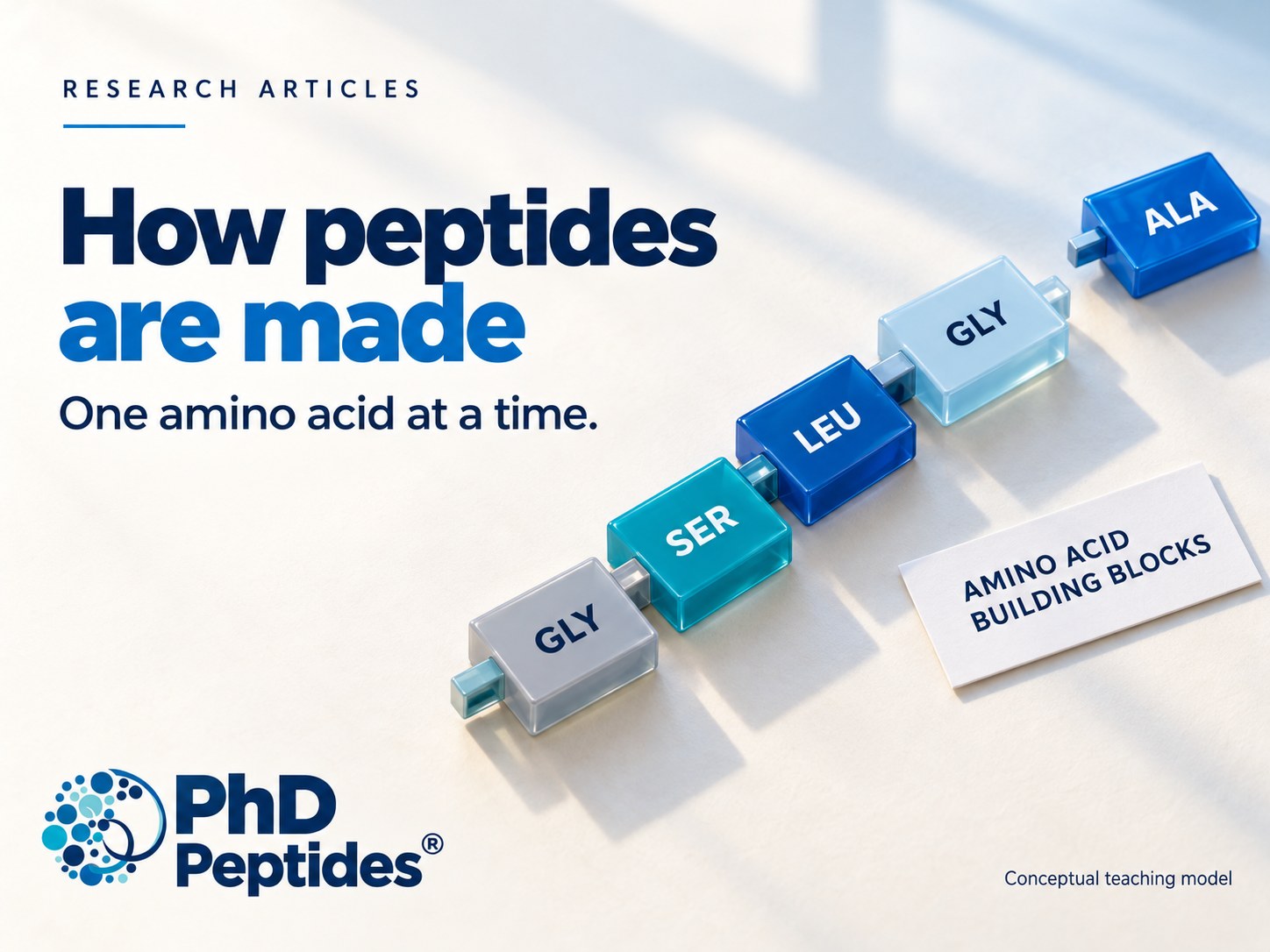
A peptide begins as an ordered sequence of amino acids. Turning that sequence into a useful research material takes more than joining the pieces together. The chain has to be assembled, separated from related material and checked with methods that describe what was actually produced.
Knowing the outline helps explain why synthesis, purification and analytical testing each deserve a place in the story. It also makes the figures on a peptide certificate of analysis much more meaningful.
The sequence is the starting plan
Peptides are chains of amino-acid residues linked by peptide bonds. Their order matters. Two chains containing the same amino acids can have different structures if those residues are arranged differently, and a change at either end can also change the molecule.
A useful specification therefore goes beyond a familiar short name. It can include the sequence, terminal groups, any modifications and the intended salt form. For a researcher comparing materials, those details help establish whether the products really refer to the same structure.
Chemical synthesis provides a way to assemble a chosen sequence. Other production routes also exist, and the best approach depends on the molecule. This article focuses on solid-phase peptide synthesis, or SPPS, a widely used method whose development earned Bruce Merrifield the 1984 Nobel Prize in Chemistry.[1]
This is a guide to the chemistry, not a description of a particular PhD Peptides manufacturing process. Use the specification and batch documentation for the product you are assessing.
How solid-phase peptide synthesis works
In a common SPPS arrangement, the growing chain is attached to an insoluble polymer support, usually described as a resin. This keeps it in place while reagents and soluble by-products are washed away. The chain is extended through repeated cycles rather than separated and collected after every individual addition.
Each cycle exposes the reactive end, adds the next suitably protected amino acid and washes away excess material. Conventional assembly proceeds from the C-terminal end towards the N-terminal end. Once the planned chain is complete, it is released from its support and the remaining protecting groups are removed under suitable conditions.[2]
Build the sequence one step at a time
- Expose the growing end
- Add the next protected amino acid
- Wash away excess material
Repeat for the planned sequence.
After assembly:
Release → Purify → Characterise
Conceptual workflow, not a synthesis protocol.
Why do amino acids need protecting groups?
An amino acid can contain more than one reactive group. Without a way to control those groups, reactions could occur at unwanted positions. Protecting groups temporarily mask selected sites so the intended bond can be formed. The choice of chemistry allows particular protections to be removed at the appropriate stage.
The terms Fmoc and Boc refer to two familiar protecting-group strategies. You do not need to memorise their reaction conditions to understand a supplier’s document. The useful idea is controlled assembly: making the intended connection while managing other reactive sites.[3]
Why purification is a separate stage
The material collected after synthesis is often called the crude peptide. It can contain the intended chain alongside related sequences and other process-derived components. Producing a large amount of crude material and producing a highly purified peptide are different achievements.
Preparative chromatography is one way to separate the desired component. Fractions are collected, assessed and selected according to the intended specification. Analytical chromatography then provides information about the resulting material. Although the same underlying separation principle may be involved, purification collects material while analysis measures it.
Closely related peptides can be challenging to separate because their chemical properties are similar. Column chemistry and separation conditions affect which components resolve from one another. Waters’ experimental work on synthetic peptide mixtures shows why choosing a suitable method matters.[4]
For a buyer, the useful outcome is a documented result against a clear specification. The synthesis method explains how a peptide was assembled. The batch report connects that manufacturing story to measured information about the resulting material.
What to look for in the finished research material
For the researcher, the most useful questions sit at the end of the manufacturing story: does the identity match, what purity was reported, what quantity was measured, and which batch does the document describe?
Consider a simple document review. You have a product specification and a certificate carrying the same batch code as your vial. The specification tells you what was required. The certificate gives you the reported result for the submitted sample. Keeping both makes it possible to explain your material choice later without relying on a screenshot of a marketing headline.
- Confirm the structure: name, sequence and modifications where relevant.
- Match the batch: keep the vial code and report together.
- Separate the measurements: identity, purity and quantity answer different questions.
- Read the method: understand what the number represents before comparing it.
- Record the next stage: preserve the link between the supplied vial and your working samples.
Our COA Library brings published batch reports together so you can make that check alongside the PhD Peptides research range. The aim is straightforward: a defined research material, supported by documentation you can read and retain.
Sources and further reading
- Bruce Merrifield, Solid Phase Synthesis, Nobel Lecture (1984).
- Bachem, Solid Phase Peptide Synthesis (SPPS) Explained.
- Thermo Fisher Scientific, Peptide Design and Synthesis: Principles and Methods.
- Waters, Synthetic Peptide Impurity Analysis on Reversed-Phase Columns (2018).
- Bachem, Quality Control of Amino Acids & Peptides: A Guide.
For laboratory research and analytical use only. This overview explains general peptide chemistry and does not describe or certify a specific manufacturer’s process.
 What does HPLC purity mean?
 How Mass Spectrometry Identifies a Peptide