


What Is NAD+? Understanding This Research Coenzyme
What Is NAD+? Understanding This Research Coenzyme
NAD+ is a coenzyme, not a peptide. Understand the name, the NAD+/NADH relationship and the details that matter in laboratory research.
NAD+ appears in a great deal of biochemical research, but one distinction is easy to miss: it is not a peptide. It is a coenzyme with a different molecular structure and a different role in laboratory studies.
That distinction matters when you are reading a paper, selecting a research material or comparing product specifications. This guide explains the name, its relationship with NADH and the records worth checking alongside a PhD Peptides NAD+ vial.
What does NAD+ stand for?
NAD is short for nicotinamide adenine dinucleotide. The word dinucleotide points to its structure: two nucleotide units joined through their phosphate groups. A peptide, by comparison, is built from a chain of amino acids linked by peptide bonds.[1]
A coenzyme is a small molecule that works with enzymes in chemical reactions. In many laboratory discussions, NAD+ is introduced through its involvement in oxidation and reduction, usually shortened to redox chemistry.
These are descriptions of the molecule. They are separate from the specification of a bottle or vial containing it. A naturally occurring cellular molecule and a supplied research reagent may share a chemical identity, but the product still has its own grade, composition, batch documentation and intended use.
PhD Peptides lists NAD+ 500mg as a research compound. Although it sits alongside peptides in our wider range, its compound class remains a coenzyme. That is the description to carry into your laboratory inventory.
NAD+ and NADH: a pair with different chemical states
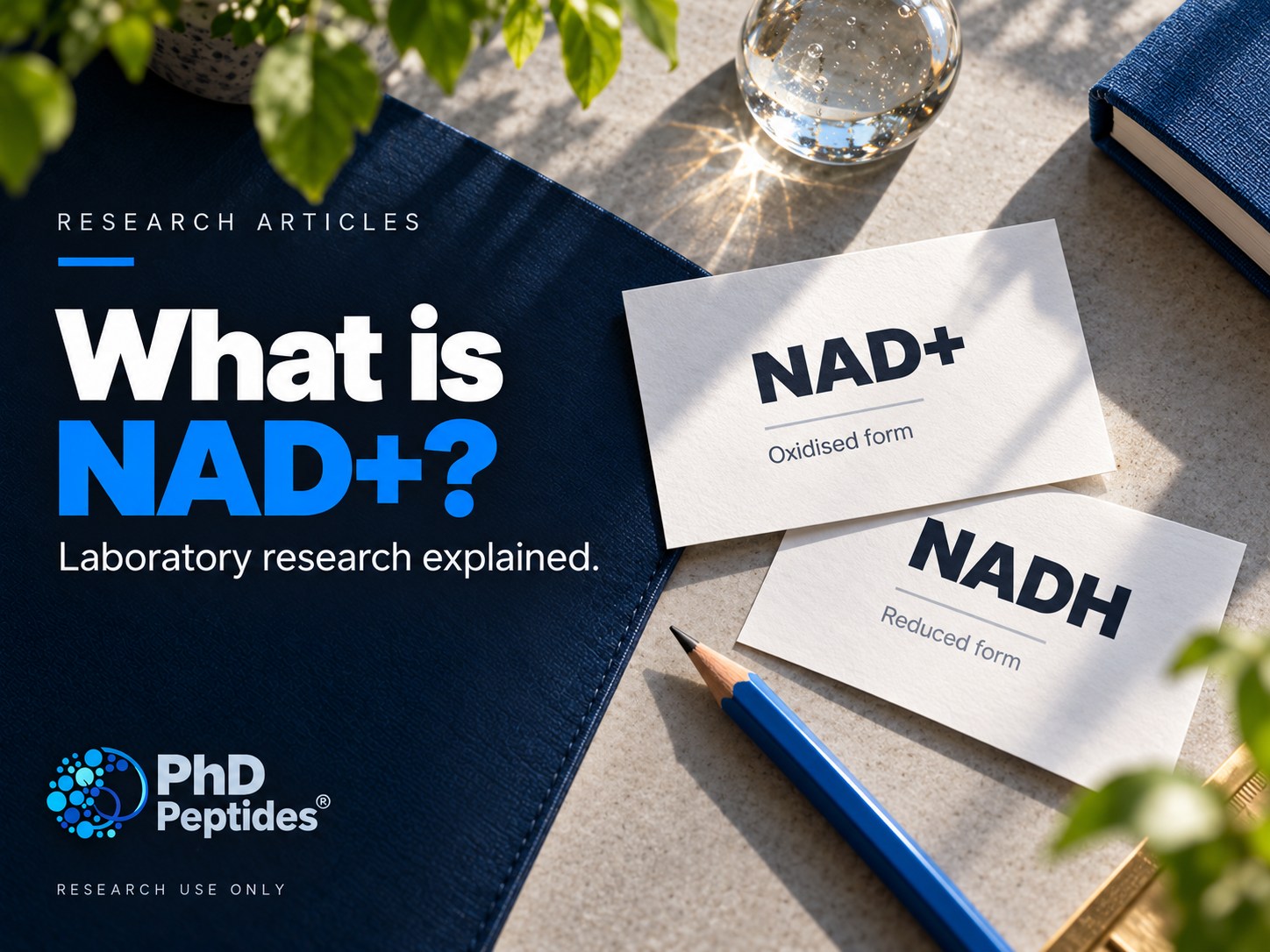
NAD+ is the oxidised form; NADH is the reduced form. In a suitable enzyme-catalysed reaction, NAD+ can accept a hydride equivalent, consisting of two electrons and one proton, to form NADH. NADH can participate in reactions that transfer this reducing equivalent onwards.[2]
A useful way to picture the pair is as the same chemical system in two states. The letters are similar because the structures are closely related. The difference matters because enzymes and analytical methods can distinguish them.
| NAD+ | NADH |
|---|---|
| Oxidised form | Reduced form |
| Can accept a reducing equivalent in a suitable reaction | Can donate a reducing equivalent in a suitable reaction |
| One member of a redox pair | The other member of the same pair |
The plus sign is part of the chemical notation, not a marker of a stronger or better product. Similarly, NADH is not simply an alternative spelling of NAD+. If a method specifies one form, check the full reagent name before comparing catalogues.
Researchers may measure either form separately, their total amount or a ratio between them. Those are different measurements. A ratio alone does not reveal how much of each was present, just as a proportion in a mixture does not reveal the mixture’s total size.
Why the measurement method matters
NAD-related research is also an analytical chemistry problem. A signal is only useful if the method preserves and distinguishes the compounds it is intended to measure.
Lu and colleagues examined extraction and quantitation of NAD-related redox cofactors, comparing methods and assessing conversion between species during sample processing. Their work illustrates why sample preparation can affect the reported balance between oxidised and reduced forms.[3]
When reading an NAD+ experiment, look for the named analyte, the sample type, the extraction method and the calibration approach. Ask whether the result concerns NAD+ alone, NADH, a combined pool or a ratio. Those labels should remain consistent from the method through to the figure caption.
Consider a hypothetical comparison between two research samples. A higher NAD+/NADH ratio might result from a change in the numerator, the denominator or both. Recording the individual measurements, where available, gives a clearer explanation than repeating the ratio without context.
The point is not to make the topic more complicated. It is to identify the question before interpreting the number. Our guide to reading research papers applies the same approach to figures, controls and experimental claims.
Reviewing PhD Peptides NAD+ research material
The PhD Peptides NAD+ 500mg product record describes a lyophilised research compound supplied in a sealed laboratory vial, with individual batch identification and published batch documentation.[6] Use that record for the supplied product specification and handling guidance.
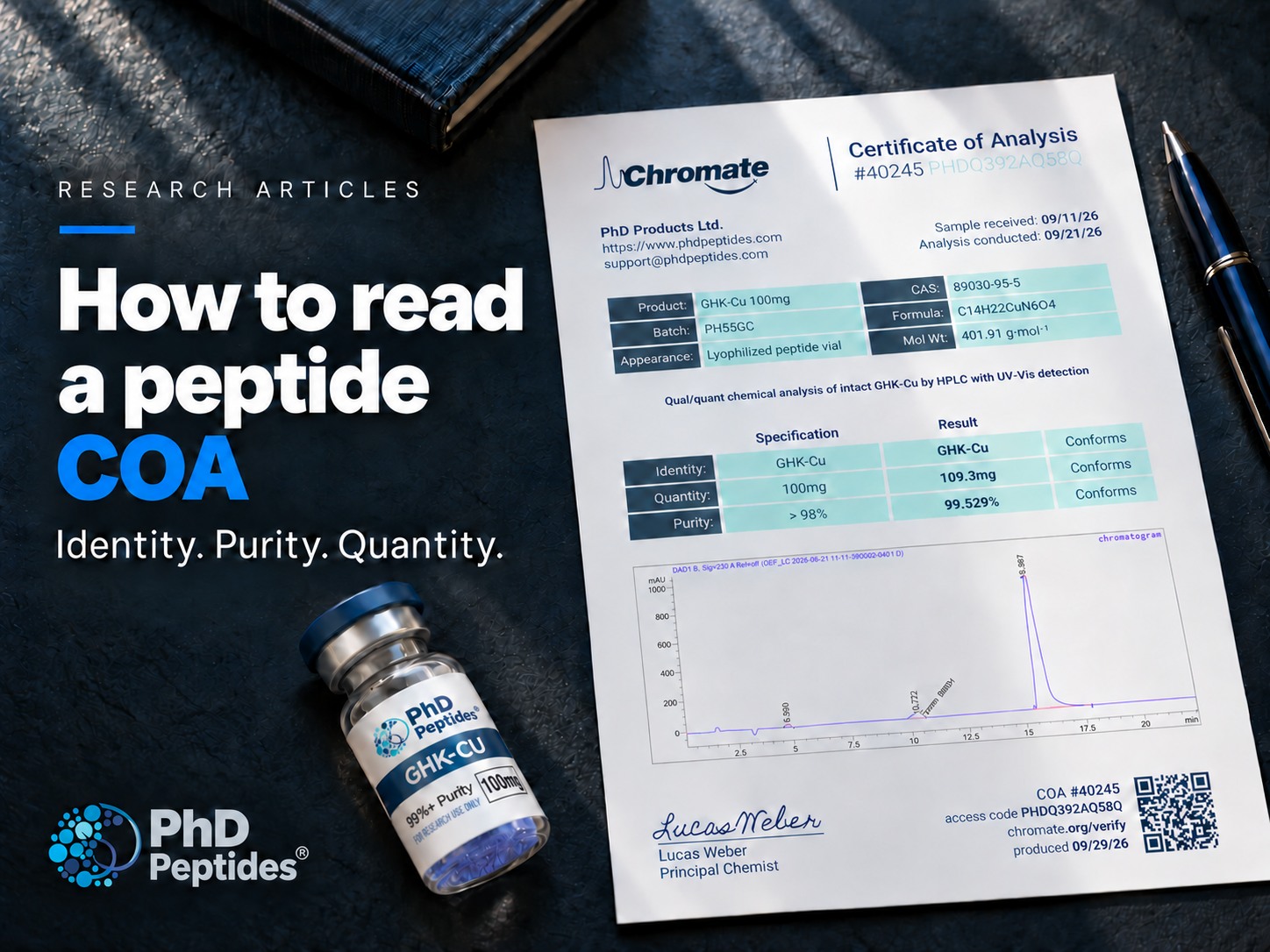
Next, match the code on your vial to its certificate in the PhD Peptides COA Library. The certificate connects the physical item in your inventory with the reported analytical results.
- Identity: confirm NAD+ and the stated chemical form, rather than NADH or another related compound.
- Batch: check that the vial and report identify the same material.
- Quantity: distinguish the labelled amount from any separately reported measurement.
- Analytical method: read what the certificate actually measures and the units used.
- Traceability: retain the original report with the purchase and laboratory records.
A useful research record combines these details rather than relying on one headline number. Our certificate-of-analysis guide explains the same documentation principles using a peptide example. For NAD+, retain the correct coenzyme identity when applying them.
Follow the current product storage guidance and the laboratory procedure appropriate to the experiment. Record relevant opening, preparation and storage events. A clear history makes it easier to compare work across different days or batches.
NAD+ questions, answered
Is NAD+ a peptide?
No. NAD+ is a dinucleotide coenzyme. Peptides are amino-acid chains, so the two belong to different chemical classes.
Are NAD+ and NADH interchangeable?
No. They are the oxidised and reduced forms of a redox pair. Use the exact form specified by the research method.
Does an NAD+ purity percentage tell me the amount in a vial?
Not by itself. Purity and quantity are separate properties. Read the label and the batch report, including the analytical method and units.
Can PhD Peptides NAD+ be used by people?
No. This is laboratory research material, not a product for human or veterinary use or consumption.
Research use only. This article explains chemistry and research documentation. It does not describe personal use. Read the PhD Peptides Research Use Only policy.
Sources and further reading
- NIH PubChem: Nicotinamide adenine dinucleotide chemical record
- NIH PubChem: NADH chemical record
- Lu et al. (2018): Extraction and quantitation of nicotinamide adenine dinucleotide redox cofactors
- NIH PubChem: Nicotinamide riboside chemical record
- NIH PubChem: Nicotinamide mononucleotide chemical record
- PhD Peptides: NAD+ 500mg product specification and current batch documentation
 How to Read a Peptide COA
 Peptide Purity vs Quantity: How Much Is in the Vial?