


How to Read a Peptide Research Paper with Confidence
How to Read a Peptide Research Paper with Confidence
Find the question, follow the evidence and keep the details that matter to your laboratory work.

You open a promising peptide paper, read the abstract twice and still cannot quite explain what the researchers did. That is a normal starting point. Scientific papers compress years of work into a few pages, and they are rarely written to be read like a magazine from beginning to end.
A better first goal is modest: identify the question, find the evidence that answers it, and understand the conditions under which that evidence was collected. You can build the detail around those three things.
Read with one question in mind
Are you learning about a peptide’s structure, comparing an analytical method, or planning a laboratory experiment? Those purposes lead you to different parts of a paper. You do not need to understand every supporting technique before deciding whether the article is relevant.
For an initial pass, read the title, abstract and section headings. Look at the figures and their captions. Write a one-sentence description of what you think the authors investigated, then test that description as you read further. Active reading of this kind is a central theme in Carey and colleagues’ practical guide to scientific papers.[1]
Keep a short list of unfamiliar terms. Look up the ones that prevent you following the main argument first. You can return to less central details later without losing the thread every few lines.
A useful first-pass sentence: “The researchers compared ___ with ___, measured ___, and found ___ under these conditions.” If one of those spaces is difficult to fill, you have found the next part to read.
Find the question, then the figure that addresses it
The introduction explains why the authors thought the work was worth doing. The results show what they measured. The discussion explains what they think it means. Keeping those roles separate helps you recognise the difference between a direct observation and a broader interpretation.
For a peptide-analysis paper, the central evidence might be a chromatogram, mass spectrum, recovery comparison or stability experiment. Begin with the figure caption and axes. Ask what the points or lines represent before reading the conclusion attached to them.
| Part of the paper | Your question | Useful note to keep |
|---|---|---|
| Introduction | What gap is the study trying to address? | The research question in one sentence |
| Methods | What material and conditions produced the data? | The details needed for your own comparison |
| Results and figures | What was actually observed? | The main finding with its units |
| Discussion | How far does the interpretation extend? | The conclusion and its stated boundaries |
| Supplementary files | Where are the extra methods and underlying data? | The file or table you may need again |
Transparent reporting makes this process easier. The MDAR framework groups essential research information into materials, design, analysis and reporting. Those categories also make a useful reader’s checklist: if a result interests you, find enough detail in each area to understand how it was obtained.[2]
A missing detail is not a reason to abandon an otherwise useful paper. Check the supplementary material, linked protocol and cited method first. Authors often put the most practical information outside the main text.
Check which peptide and which experimental conditions were used
Start with the material. A familiar name can conceal differences in sequence, terminal groups, chemical modification or salt form. Confirm the structure described in the paper before treating it as equivalent to a product specification.
Then look for the supplier, product identifier and any characterisation the authors report. Identity and purity information help establish what entered the experiment. NIH’s guidance on research resources highlights why important chemicals need appropriate authentication, even when obtained from an outside supplier.[3]
For an analytical study, note the instrument, sample preparation, solvent, measurement basis and calibration. For a stability comparison, add time, temperature and container information. These details help explain whether an apparent difference between studies might come from the experimental setup.
Here is a simple example. One paper reports a peptide result as chromatographic area percentage. Another reports peptide content by mass. Both may contain useful measurements, but the percentages answer different questions. A direct ranking would overlook the reporting basis. Our guide to purity and quantity explains this distinction.
When selecting PhD Peptides material for a project, retain the matching report from the COA Library beside your notes. That connects the literature you read with the particular batch you eventually use, rather than leaving the two records separate.
Ask what was repeated, and what the error bars mean
“Three measurements” can describe different things. Three readings from one preparation are technical repeats. Independently prepared or biologically independent samples provide a different kind of information. In biological experiments, several wells from the same preparation should not automatically be treated as independent biological replicates.
Check the caption’s definition of n. Nature’s guidance on replicates asks authors to describe precisely what was repeated so readers can assess the variation being represented.[4]
Also read the axis labels and error-bar definition. A percentage needs a denominator. A “relative” signal needs a reference. An average without a description of its variation leaves you with less information than the graph’s tidy appearance might suggest.
A small difference needs the right context
Suppose a figure shows two nearby values from different methods. Before deciding that one is better, ask whether the methods measure the same property and whether the observed difference is meaningful for the research question. A result can be precisely reported and still answer a narrower question than the title suggests.
You do not need to become a statistician to read carefully. Start by identifying the comparison, the independent experimental units and the uncertainty the authors actually show. If the statistical method is unfamiliar, make that a question to resolve rather than silently treating the number as a verdict.
Finish with a note you can use in six months
A page full of highlighted sentences is harder to revisit than a short note in your own words. Record the paper’s title or DOI, the material studied, the main result and why it matters to your project. Add the figure or supplementary table that supports your summary.
- Question: what did the authors set out to investigate?
- Material: which peptide and form were used?
- Evidence: what observation supports the main finding?
- Conditions: which experimental details matter for comparison?
- Next step: what do you need to check or read next?
Save a link to the publisher’s page, not only a downloaded PDF. Papers can receive corrections or other updates. Where available, Crossref’s Crossmark service helps readers check the current status of an article and find linked changes.[5]
Finally, try explaining the study aloud in a few sentences. If you can describe the question, the measurement and the result without borrowing the abstract’s wording, you have a useful understanding to build on. The purpose is not to finish every paper quickly. It is to come away with something clear enough to inform your next laboratory decision.
Sources and further reading
- Carey, Steiner and Petri, Ten Simple Rules for Reading a Scientific Paper, PLOS Computational Biology (2020).
- Macleod et al., The MDAR Framework for Transparent Reporting in the Life Sciences, PNAS (2021).
- NIH, Authentication of Key Biological and/or Chemical Resources.
- Nature, Guidance on Technical vs Biological Replicates.
- Crossref, Crossmark: Checking the Current Status of Research.
This guide concerns reading scientific literature for laboratory research and analytical work. Product selection should follow your research protocol and the relevant material documentation.
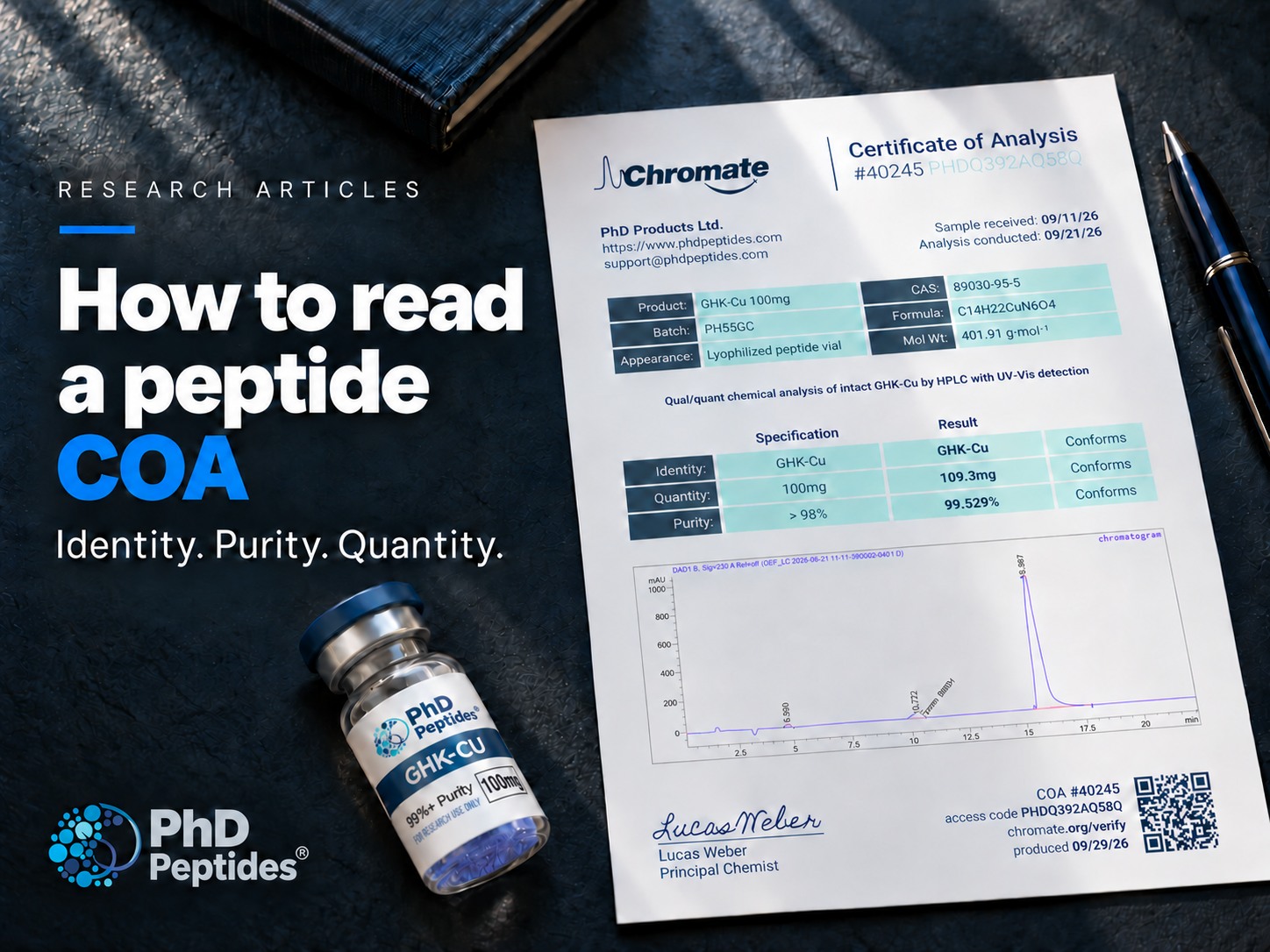 How to Read a Peptide COA
 Sequence, Mass and CAS Numbers