


How Lyophilisation Is Used for Research Peptides
Laboratory Methods
How Lyophilisation Is Used for Research Peptides
Follow water from a frozen material into vapour, and discover why a peptide’s dry appearance, measured content and storage history answer different questions.
A laboratory reference. No dosing or administration guidance.
Lyophilisation, or freeze-drying, removes water from a frozen material under reduced pressure. Freezing, primary drying and secondary drying each play a different role. Understanding them helps a researcher distinguish the material’s processing history from its analytical properties.
A vial of research peptide may contain a neat cake, a thin deposit or a less uniform dry solid. The word “lyophilised” explains something about how that material was produced. Its appearance raises a different question: what can a dry-looking solid actually tell you?
The process is more interesting than simply leaving a solution to dry. It begins with freezing, then removes water through controlled stages. Following those stages explains why the finished appearance, residual moisture and peptide content deserve separate attention.
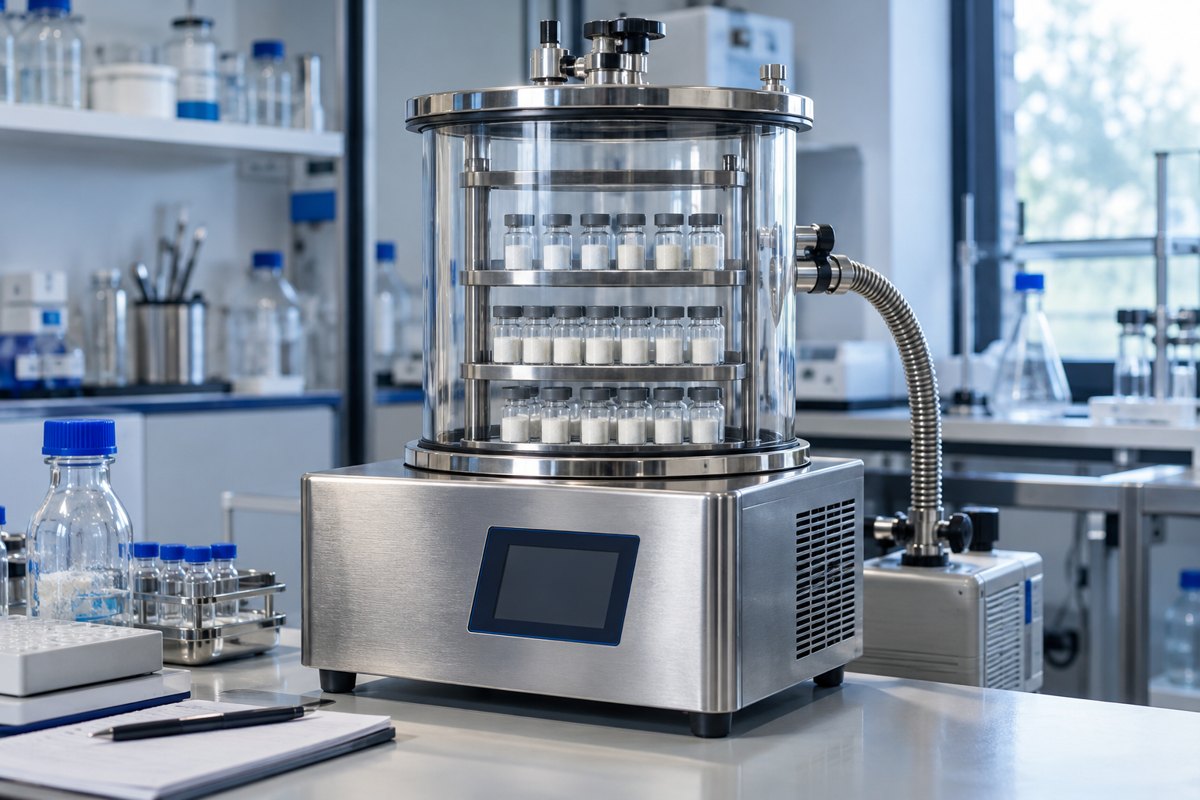
Water takes a different route out
In ordinary evaporation, liquid becomes vapour. During the primary drying stage of lyophilisation, ice passes directly from solid to vapour: sublimation. The starting material is therefore frozen before this water-removal stage begins.
The FDA’s historical pharmaceutical inspection reference describes the three stages and their process controls. It provides a physical-process reference without assigning pharmaceutical status to research materials. FDA: lyophilisation process reference.
The frozen starting point
As water forms ice, the remaining unfrozen solution becomes more concentrated. The material entering drying is therefore a frozen system whose different components do not all occupy the same state.
Primary drying: removing the ice
The principal ice-removal stage uses sublimation under reduced pressure. Heat transfer and vapour removal are part of the process, so the cycle involves more than keeping a chamber cold.
Secondary drying: the moisture that remains
After the principal ice-removal stage, further drying removes associated moisture by desorption. The different roles of these stages are also described in the protein-solids review cited here. Review: freezing and drying stages.
Lyophilisation: the conceptual sequence
The formulation is brought into a frozen state.
Frozen solvent is removed mainly by sublimation.
Further desorption reduces residual moisture.
Conceptual overview, not a manufacturing protocol or stability guarantee.
Why a drying cycle is designed for a material
A formulation has its own behaviour during freezing and drying. The heat supplied, water removed and condition of the product need to be considered together. A process cannot be assessed solely by how quickly a vial looks dry.
A review of pharmaceutical protein solids discusses temperature, chamber pressure, heat transfer, collapse and moisture-related behaviour. These provide useful process context, while the findings for particular protein formulations should not become a universal rule for short research peptides. Pharmaceutical protein solids: drying, characterisation and stability.
For a reader outside manufacturing, the useful distinction is between a process description and a characterised outcome. “Lyophilised” names the process. The analytical record describes the resulting material. Neither needs to be asked to do the other’s job.
A dry solid can still have a chemical history
Removing water does not make processing chemically irrelevant. Chandrasekhar and Topp studied disulfide-containing model peptides through lyophilisation and solid-state storage. They observed stage-dependent disulfide changes, including loss and subsequent regeneration under their studied conditions. The result is specific to that model, and demonstrates why chemical behaviour deserves investigation alongside the physical drying stages. Chandrasekhar and Topp: peptide disulfide exchange during lyophilisation.
The laboratory question follows naturally: which measurements describe the property that matters to this research? A content result addresses amount. Identity evidence addresses the stated compound. A stability study follows specified properties over time and under defined conditions.
This lets the researcher connect processing information with the evidence needed for the experiment, without assuming that every material undergoes the same changes.
Residual moisture needs a value, not a visual guess
A vial may look dry without supplying a measured water-content value. The visible solid’s size and shape are similarly different from an assigned amount of target peptide. A photograph can help describe an unexpected receipt, but an assay is needed to assign an analytical property.
Moisture is one variable in a dried material’s behaviour, and the relevant conditions depend on the material. The protein-solids review discusses these relationships; it does not supply one moisture target or shelf life for every peptide. Review: moisture and solid-state stability.
This is why documented storage information is more useful than a general assumption that dry material remains unchanged. A storage recommendation describes conditions to follow. Evidence for a stability period additionally needs the period, measurements and criteria that support it.
Keep the process claim within its boundaries
Lyophilisation explains water removal. It does not itself measure peptide purity or content, assign a shelf life or establish sterility. The FDA reference treats contamination control as an additional concern rather than an automatic consequence of drying. FDA: contamination-control context.
A useful interpretation brings the pieces together: the material was processed in a stated form, its appearance was observed, its analytical results describe defined properties, and its storage information has a stated basis. That gives “lyophilised” its proper place in the research record.
The process in perspective
- Freezing, primary drying and secondary drying have distinct roles.
- Appearance and measured peptide content answer different questions.
- Processing and moisture behaviour depend on the material.
- Identity, stability and microbiological properties need their own evidence.
Sources and reading
Laboratory scope: This process overview concerns research materials and analytical interpretation. It is not a manufacturing protocol or guidance for human or veterinary use.