


How to Store Lyophilised Research Peptides
How to Store Lyophilised Research Peptides
Cold storage is only part of the story. Understand moisture, handling and the records that help keep your research material consistent.
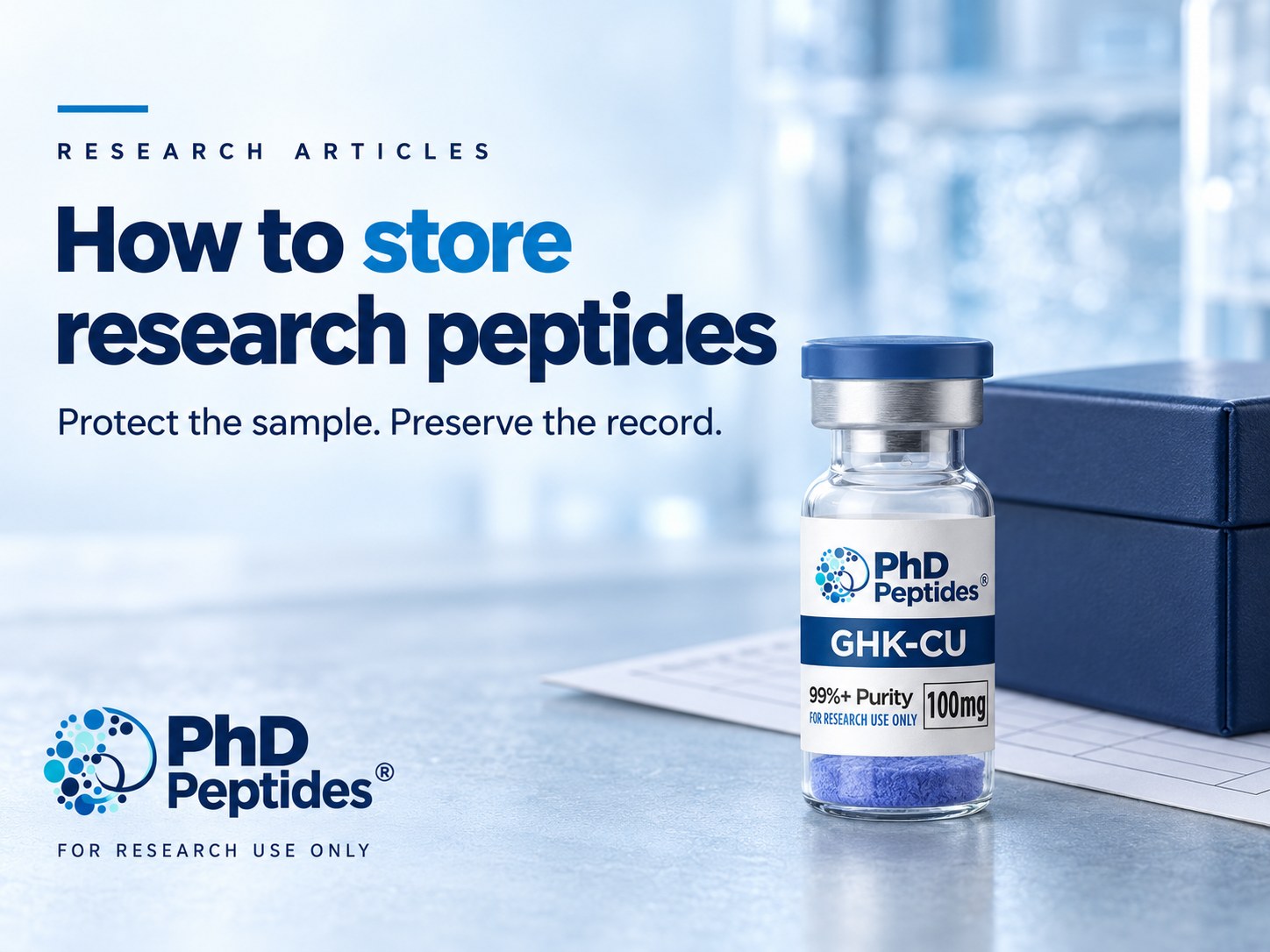
The best storage routine is the one that leaves you confident about the material when the next experiment begins. That means knowing where the vial has been, keeping its condition consistent and being able to find the matching batch record.
Lyophilised research peptides arrive as a dry powder or porous cake because removing water can make them easier to store than a prepared solution. The remaining details still matter: the sequence, the container, temperature, moisture and how often the material is handled. A freezer setting is one part of the answer.
This guide explains the reasoning behind sensible peptide storage, so the instructions on a product label make more sense. Use the guidance supplied for your particular material and your laboratory’s procedure to decide the actual storage conditions.
Start with the vial you have
Before putting a delivery away, check the product name, batch code, stated quantity and any storage information supplied. Give the vial a defined location in your inventory, then save its certificate alongside that entry. These small steps make it much easier to repeat work months later.
At PhD Peptides, the COA Library lets you find published reports by product or batch. Record the code from the vial itself. A certificate describes the tested sample; your storage record documents what happened to your material after receipt.
Where a label specifies a temperature, follow it. Manufacturer guidance often recommends frozen storage for dry peptides, but the appropriate temperature and duration depend on the peptide and formulation. A general guide cannot turn one storage interval into a guaranteed shelf life for every sequence.[1]
Three records worth keeping together: the vial’s batch identity, the matching analytical report and the laboratory’s storage history. Together, they are more informative than a date written on the lid.
Why cold and dry work together
Cooling usually slows chemical change. Keeping a lyophilised material dry limits the moisture available to participate in reactions or alter the solid. That is why a tightly closed container and sensible protection from humidity belong alongside temperature control.
In a study of a six-residue model peptide, researchers varied moisture, temperature and formulation. All affected stability, and their effects depended on the surrounding formulation. The useful lesson is that storage conditions interact. It is not a shelf-life study of PhD Peptides products.[4]
A dry-looking cake can still contain residual moisture. Nor can its size tell you how much peptide is present. If you need a measured quantity, consult the relevant analytical result rather than judging the material by eye.
| Factor | What it helps control | Useful laboratory habit |
|---|---|---|
| Temperature | Rate of chemical changes | Use the specified conditions and monitor the storage unit. |
| Moisture | Changes in the dry material | Keep the container closed and follow your dry-storage procedure. |
| Light and air | Exposure that may affect sensitive sequences | Use the stated protective packaging and handling conditions. |
| Time | How long the material has experienced those conditions | Record receipt, opening and preparation dates. |
For a shared laboratory freezer, a box map is surprisingly useful. It reduces the time spent searching with the door open and avoids repeatedly handling neighbouring samples. Put the location in the same inventory entry as the batch code.
Let a cold, closed vial equilibrate before opening
Think of a cold glass taken into a warm room: water can collect on its surface. Opening a cold peptide container exposes the contents to humid air. Allowing the closed container to reach ambient temperature before opening helps reduce moisture uptake. Follow any desiccator instructions supplied for the material.[2]
The practical detail is closed. Leaving the lid off while the sample warms defeats the purpose. Plan the task first, prepare the required equipment and keep the time spent with the container open appropriate to your laboratory procedure.
Light and oxygen sensitivity also depend on the sequence. Manufacturer guidance highlights particular care for residues such as cysteine, methionine and tryptophan. This is a reason to check the product information, rather than assume every peptide responds identically to routine handling.[3]
There is no universal warming time that fits all vial sizes, containers and room conditions. Use the laboratory’s validated handling procedure instead of a fixed number copied from an unrelated product.
Make the storage record useful to the next person
A good record is short enough that people actually complete it. The example below is an organisational checklist, not a test certificate or a claim about any particular batch.
- Material: full product name, batch code and supplier.
- Arrival: receipt date, packaging condition and any relevant observations.
- Location: storage unit, box and position.
- Conditions: required temperature and the monitoring record used by the laboratory.
- Handling: first opening, preparations made and any unusual exposure.
- Documents: certificate, product instructions and internal procedure.
Suppose two preparations from the same batch give different results. Knowing that one was prepared immediately and the other after several weeks of different handling gives you something specific to investigate. Without the record, both may look identical in the experiment notebook.
If a freezer interruption occurs, record the available time and temperature information, keep the material identifiable and assess it against the supplier’s advice and your intended assay. A brief excursion does not have one universal outcome. Neither the visual appearance nor the original certificate can reconstruct the missing exposure history.
A prepared solution needs its own plan
Once a peptide is dissolved, the solvent, pH, concentration and container become part of its storage conditions. The dry product’s shelf life should not simply be copied onto the solution label. AnaSpec’s handling advice likewise distinguishes the dry material from solutions and stresses moisture control before opening.[5]
Plan working portions around the experiment so that the same stock is not repeatedly warmed, sampled and returned to storage. Where appropriate for the validated method, separate aliquots can make handling more consistent. Thermo Fisher’s guidance advises avoiding repeated freezing and thawing of peptide solutions.[3]
Label each preparation with its identity, parent batch, preparation date and the conditions your method requires. Record any solvent or buffer separately from the peptide identity. That way, another researcher can distinguish a fresh preparation from a stored one without guessing.
When choosing material for a new project, explore the PhD Peptides research range and review the available batch documentation before planning storage. Clear information at the beginning makes the rest of the workflow easier.
A few useful answers
Should all research peptides be stored at the same temperature?
No. Follow the product-specific guidance. General manufacturer advice provides a starting point, while the peptide, formulation and intended storage duration determine the appropriate conditions.
Does a normal-looking cake confirm that the peptide is unchanged?
Appearance is useful to record, but it does not measure identity, purity or remaining quantity. Those questions require suitable analytical methods.
Can I use the original COA as a storage certificate?
The COA documents the tested sample and reported results. Keep it with your records, but use a separate storage history to document conditions after receipt.
Sources and further reading
- Bachem: Handling and storage guidelines for peptides
- Merck / Sigma-Aldrich: Handling and storage guidelines for peptides and proteins
- Thermo Fisher Scientific: Handling and storage instructions for standard peptides
- Oliyai et al. (1994): Solid-state chemical instability of an aspartyl residue in a model hexapeptide
- AnaSpec: Peptide frequently asked questions
 Why peptides are freeze-dried
 Every batch has a story