


Why Are Research Peptides Freeze-Dried?
Why Are Research Peptides Freeze-Dried?
The science behind lyophilisation, the cake in your vial and the reason its size does not measure peptide quantity.
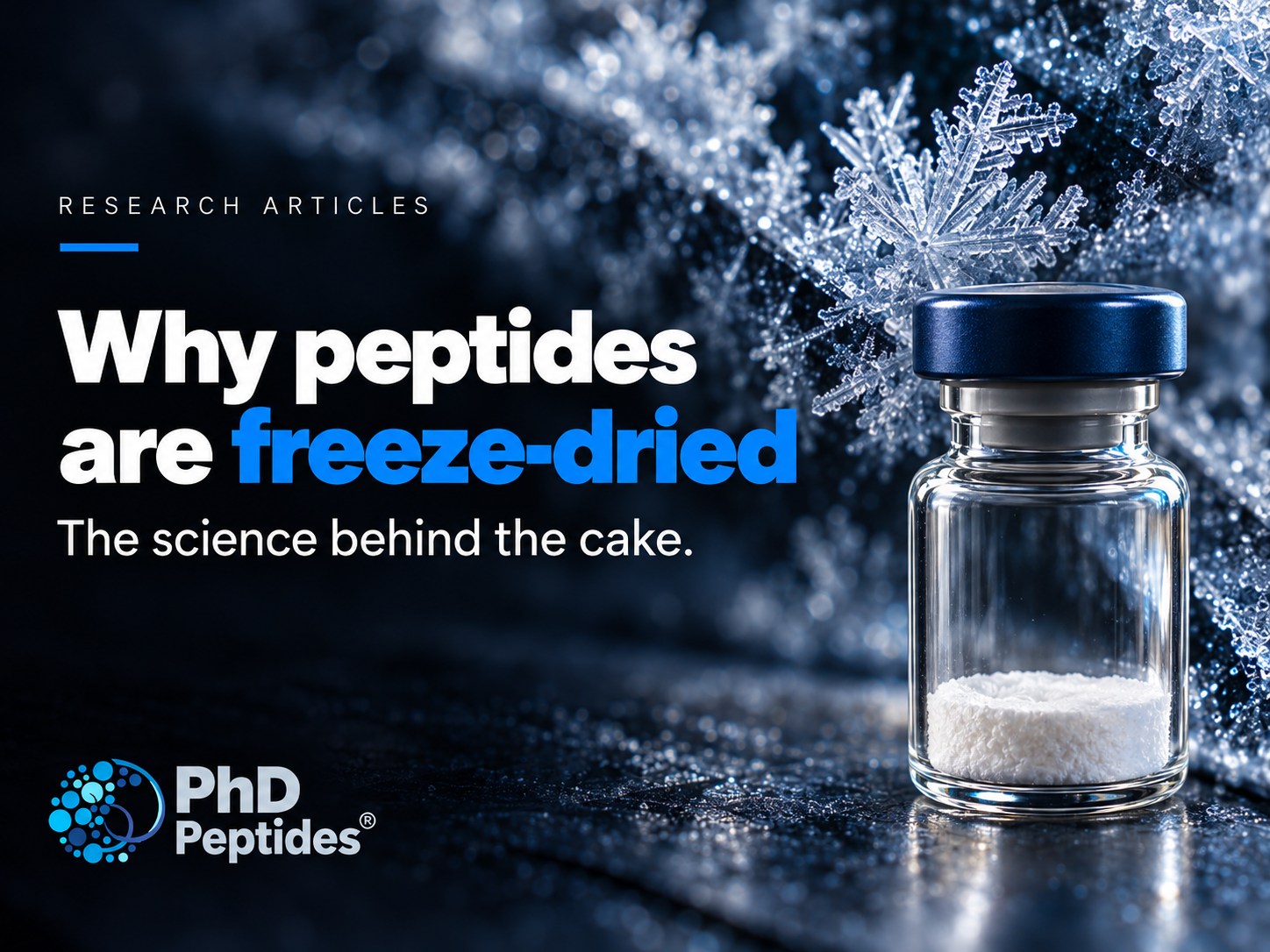
The pale disc at the bottom of a peptide vial can look almost weightless. Sometimes it is neat and compact; sometimes it resembles a loose powder. That appearance has a story: much of the water was removed while the material was frozen.
The process is called lyophilisation, more often known as freeze-drying. It is widely used to prepare delicate research materials in a dry form. Understanding it explains why a vial contains a cake, why cakes need not match in size and why storage still matters after drying.
This is a guide to the physical process and the material you receive. It is not a formulation recipe or a description of a particular manufacturer’s drying cycle.
Why supply a peptide in a dry form?
Water is useful when preparing a laboratory solution, but it can also support chemical changes during storage. Removing much of that water can help preserve materials that are less stable in solution. Freeze-drying does this without relying on the prolonged high temperatures associated with some other drying methods.[2]
The benefit is practical: a dry research material can be documented, stored and later prepared for a particular laboratory method. The exact stability still depends on the compound, formulation, packaging and storage conditions. “Freeze-dried” describes a process, not an unlimited shelf life.
For a new researcher, it helps to separate the physical form from the analytical results. Lyophilised describes how the material was dried. A purity result describes an analytical measurement. A quantity result describes the amount reported. All three can appear on the same product page because they tell you different things.
How lyophilisation works, in three stages
1. Freezing creates the starting structure
The liquid material is frozen. Ice formation separates much of the water from the remaining components and helps establish the structure that drying will leave behind. Freezing conditions are part of the process design because the size and arrangement of ice crystals influence later drying behaviour.[3]
2. Primary drying removes ice
The pressure is reduced so that ice can pass directly into water vapour. This change from solid to gas is called sublimation. The vapour travels away from the sample and is collected on a colder surface within the drying system. Controlled heat supplies energy for the process while the product is kept within suitable conditions.[1]
3. Secondary drying reduces remaining moisture
Once the ice has been removed, some water remains associated with the material. Secondary drying removes more of this water by desorption, using conditions chosen for the product. The process is designed to leave a suitable residual moisture level rather than necessarily containing absolutely no water.[2]
Three stages of freeze-drying
- FreezingIce forms in the material.
- Primary dryingIce becomes vapour by sublimation.
- Secondary dryingRemaining moisture is reduced.
A schematic overview, not a drying recipe or batch record.
The detail behind these apparently simple stages is why lyophilisation is a controlled process. The 2023 scientific update by Tchessalov and colleagues examines how formulation properties, heat transfer and equipment conditions shape cycle design.[3]
What is the cake?
The cake is the solid structure left as water is removed. It is often porous, with spaces through which vapour travelled during drying. It may remain as a coherent disc or break into fragments or powder. The word describes its physical appearance, rather than a separate ingredient.
During primary drying, vapour must move through the layer that has already dried. BÜCHI’s explanation of sample geometry describes this advancing drying boundary and why the depth and arrangement of material influence the process.[5] The structure you see is therefore linked to how the original material occupied the vial, as well as how it dried.
A cake is not solid peptide packed without spaces. Its visible volume includes its structure. That is why looking through the glass is not a substitute for a quantity result.
Depending on the formulation, dried material can contain counterions and residual moisture as well as peptide. Some freeze-dried formulations use additional ingredients to support their structure or stability. Their presence is formulation-specific; you should not infer an ingredient list from the shape or colour of a cake.
Why can 5 mg and 10 mg cakes look similar?
Two vials do not have to differ visibly in cake height simply because their nominal peptide amounts differ. The original fill volume, vial geometry and drying conditions all affect the resulting structure. The quantity of peptide is only one part of that picture.[3]
Think about the difference between volume and mass. A loosely arranged powder can occupy more space than a compact piece of the same material. A porous cake has a similar distinction: its height tells you something about its structure, but not a reliable milligram value.
| What you can observe | What to use alongside it |
|---|---|
| Cake height or visible powder volume | The reported quantity and its measurement basis |
| Colour and physical form | The product description and any batch appearance record |
| Vial label and batch code | The matching certificate and your receipt record |
| Condition of closure and packaging | Your laboratory’s receiving procedure |
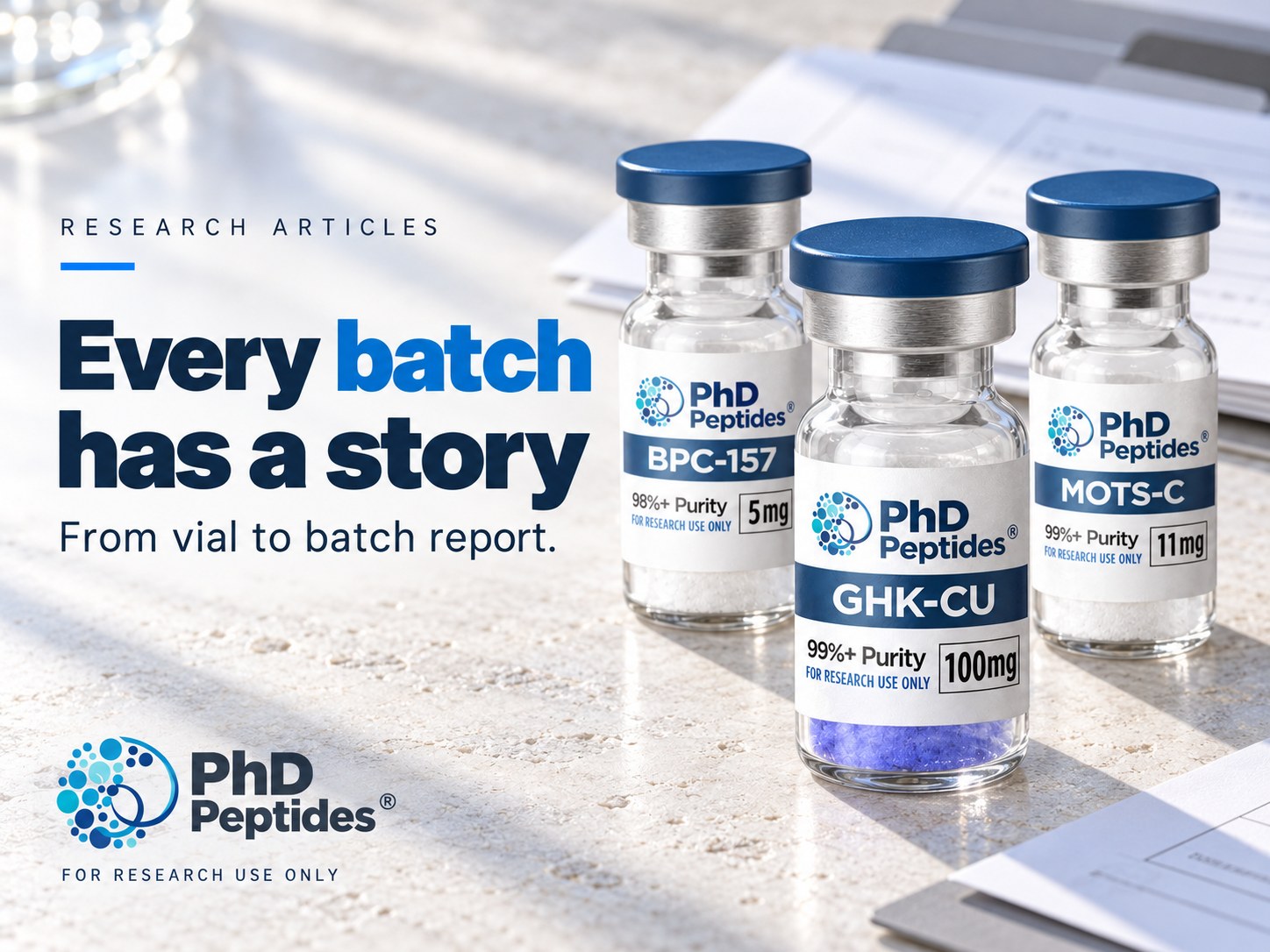
For PhD Peptides materials, match the batch code on the vial to the published COA. It is a much more useful starting point for assessing the reported amount than comparing two cake photographs.
Dry material still deserves careful storage
Freeze-dried peptides can absorb moisture from the surrounding air. Bachem’s handling guidance recommends allowing sealed cold samples to reach room temperature before opening, so moisture does not readily condense onto the material. It also advises minimising exposure and resealing promptly.[4]
Follow the product-specific storage information and your laboratory’s procedures. Keep the batch label readable, preserve the original packaging information and record receipt and opening as appropriate. If material is transferred into another container, retain a clear link to the original vial.
Before your first use of a product, read the storage instructions together with its certificate. That gives you the handling context and the analytical record in one place. Our storage guide develops the practical steps, while the research peptide range provides product-specific information and links to available batch documentation.
Once you understand how the cake forms, its appearance becomes easier to interpret. Use the physical checks for condition, the label for identity and traceability, and the certificate for the reported analytical results.
Sources and further reading
- Labconco: Freeze-Drying Frequently Asked Questions
- BÜCHI: Freeze Drying, principles and benefits
- Tchessalov et al.: Practical Advice on Scientific Design of Freeze-Drying Process, 2023 Update
- Bachem: Care and Handling of Peptides
- BÜCHI: Sample geometry and the movement of the sublimation front
For laboratory research and analytical use only. The sources explain scientific principles and do not imply endorsement of PhD Peptides. See our Research Use Only policy.
 Purity vs quantity
 Every batch has a story