


Why That Batch Number Matters to Your Experiment
Why That Batch Number Matters to Your Experiment
Connect your vial, certificate and experimental record with a simple approach to batch traceability.

Six months after an experiment, a colleague asks which batch you used. If the answer is already beside your results, the conversation takes seconds. If it is not, you may be searching old emails, labels and downloads for the rest of the afternoon.
That is the everyday value of batch traceability. A short code connects a physical material to its documents and then to the work performed with it. For research peptides, it is one of the simplest habits that makes an experimental record more useful.
The aim is not to build an elaborate filing system. It is to make sure you can follow the material’s story from the vial to the certificate and back to your experiment.
A product name tells you what. A batch tells you which.
A catalogue name identifies the product you intended to buy. The batch or lot code identifies a particular defined group of material associated with its production and documentation. Two vials can carry the same product name but belong to different batches.
That distinction matters when you read a certificate. A current product page may display the newest available report, while a vial already in your laboratory belongs to an earlier batch. The code on your actual vial is therefore the starting point for finding its matching documentation.
NIH’s guidance on research resources highlights why identity and validity deserve attention: important chemical and biological resources can vary over time or between laboratories, and those differences can influence research data.[1] Recording a batch is not the whole of resource authentication, but it gives that wider process a clear reference.
A practical distinction: the product name helps you reorder; the batch code helps you explain what was used in a particular experiment.
Connect the vial, certificate, sample and experiment
The strongest record has four simple links. First, the original vial label identifies the supplier’s material. Second, the certificate provides the reported analytical results. Third, your laboratory’s sample identifier tracks the material after receipt. Fourth, the experiment record says where that sample was used.
Four links in a batch record
- VialSupplier batch code
- CertificateMatching laboratory report
- Sample IDYour laboratory reference
- ExperimentRecorded use of that sample
Keep these links when material changes container or location.
If you transfer material to another container, do not leave its identity dependent on memory. Label the new container according to your laboratory procedure and record the relationship to the original batch. An internal sample code can be short, provided it points to a complete record.
OECD Good Laboratory Practice principles require clear identification and records for test items and specimens within their regulated scope.[3] Most readers will have their own institutional requirements; the useful general habit is to preserve identity when a material is received, moved, prepared or archived.
Keep digital files easy to find too. A report saved as “certificate-final-new.pdf” is less helpful than one that includes the product, batch and report reference. National Academies guidance on research records stresses the importance of describing and locating data clearly enough for it to be found again.[2]
Make receipt the moment you capture the details
The easiest time to build a reliable record is when the material arrives, while the packaging, order information and vial are together. A routine taking a few minutes can avoid a much longer reconstruction later.
- Read the label. Record the exact product name, nominal quantity and batch code. Check the material against your order.
- Find the matching report. Search by the vial’s batch code and verify the product details. Save the complete certificate.
- Create your sample entry. Add the receipt date, storage location and your laboratory’s internal identifier.
- Record the condition. Note packaging or label issues and resolve any mismatch before the material is used.
- Link the experiment. Use that same sample reference in the relevant notebook, worksheet or electronic record.
At PhD Peptides, the COA Library is designed to make the report-finding step straightforward. Search for the product or batch, then compare the certificate with the label in front of you. Our COA reading guide explains which details to check once you have opened it.
If your group shares a freezer or store, agree where the record lives. A central entry that everyone can find is more useful than three slightly different spreadsheets. Include enough detail for another researcher to locate both the physical vial and its documentation.
When a new batch arrives
A change of batch is a good point to pause and compare the new documentation with your existing record. Check the reported properties that matter to your work, including identity, purity, quantity and any method details your protocol requires.
You do not need to assume that a new batch will behave differently. You do need to make the change visible. Record when you began using it, which experiments used each batch, and any comparison or acceptance checks required by your laboratory.
For a long study, this makes later interpretation easier. If results shift, the batch history is available alongside other variables such as instrument settings, reagents and preparation dates. If results remain consistent, the same history strengthens your account of how the work was carried out.
Batch traceability is not measurement traceability
The terms sound similar but refer to different connections. Batch traceability follows material and records. Metrological traceability relates a measurement result to a reference through a documented calibration chain, including measurement uncertainty.[4] You can keep an excellent batch record without claiming that a result is traceable to a national measurement standard.
A simple entry you can adapt
| Record field | What to enter |
|---|---|
| Material | Supplier, exact product name and nominal quantity |
| Supplier batch | The code printed on the received vial |
| Certificate | Laboratory, report reference, date and saved-file location |
| Reported properties | Relevant results, units and methods |
| Laboratory sample ID | Your internal identifier and storage location |
| History | Receipt, preparation and use records required by your procedure |
You can keep this in a notebook, a structured spreadsheet or an electronic laboratory notebook. The format is less important than consistency, accessibility and a clear link back to the original material.
When choosing research peptides, consider the supporting documentation as part of the product. A batch code and an accessible matching certificate make it easier to move from purchasing to well-documented laboratory work.
Sources and further reading
- NIH: Rigor and Reproducibility Resource Chart, authentication of key resources
- National Academies: Guidelines on Research Data and Manuscripts
- OECD: Principles on Good Laboratory Practice
- NIST: Metrological Traceability, Frequently Asked Questions
For laboratory research and analytical use only. The sources explain scientific principles and do not imply endorsement of PhD Peptides. See our Research Use Only policy.
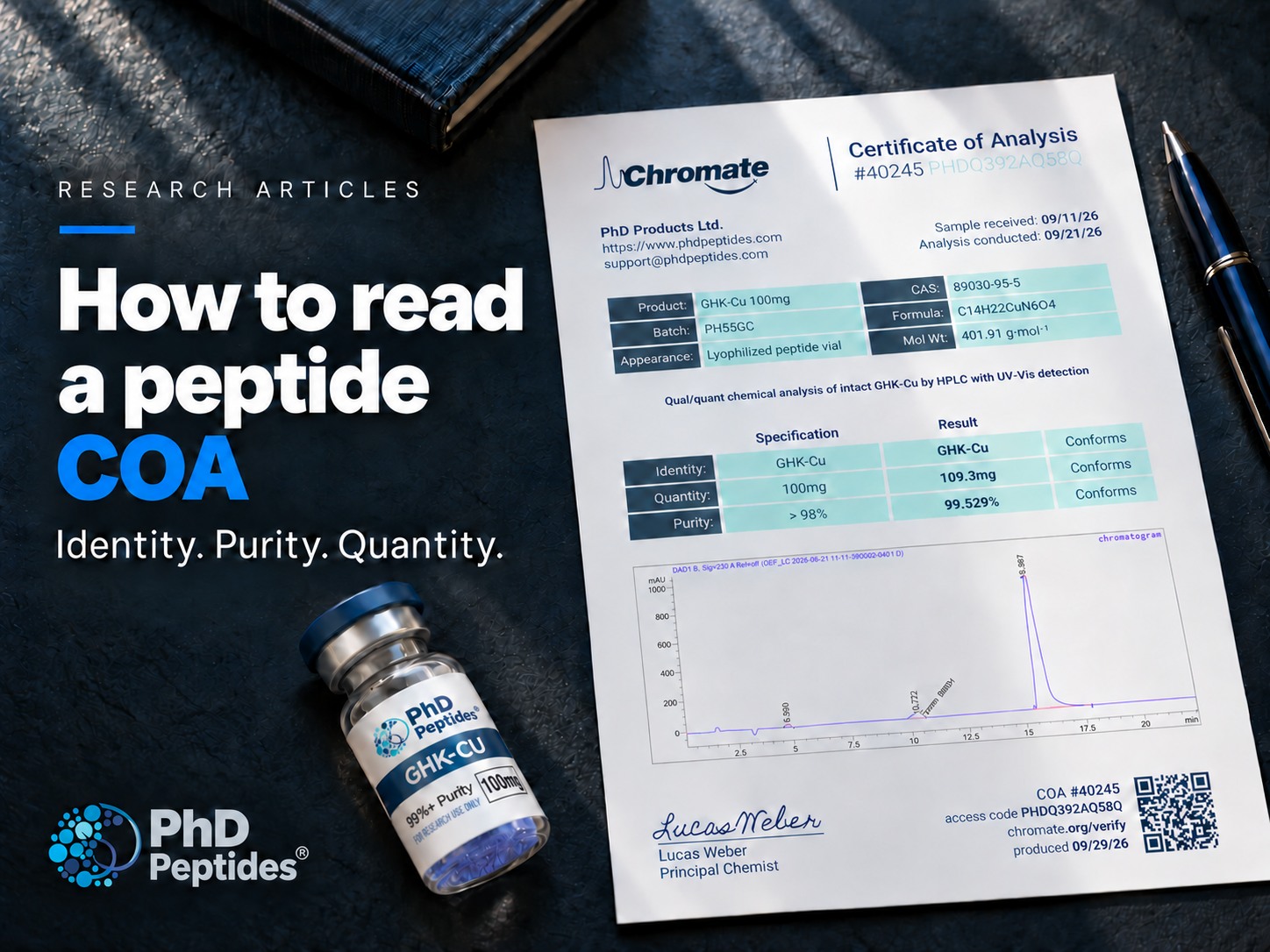 How to Read a Peptide COA
 Independent peptide testing