


Third-Party Peptide Testing: What Makes a Report Useful?
Third-Party Peptide Testing: What Makes a Report Useful?
A practical guide to the laboratory, methods and batch details behind an independent peptide test.
The most useful part of “independently tested” is the report you can actually open. It turns a broad statement about quality into something you can read, match to a batch and keep with your research.
Third-party peptide testing means that analysis is carried out by a laboratory separate from the product’s supplier or manufacturer. For a new researcher, the next step is straightforward: establish who tested what, how it was measured and which batch the results belong to. You do not have to become an analytical chemist to make that first assessment well.
What does an outside laboratory add?
An outside laboratory provides a separate analytical view of a submitted sample. That can make a supplier’s product information easier to assess, particularly when the original report identifies the sample clearly and explains the methods behind the results.
Keep three roles distinct. The supplier offers and documents the product. The laboratory analyses the submitted material. The researcher decides whether those documented properties fit the intended experiment. When each part is clear, purchasing decisions and laboratory records become much easier to explain.
The useful question is specific: “Can I see the report for this batch?” It takes you directly from a general quality statement to the information you need.
The details that make a report useful
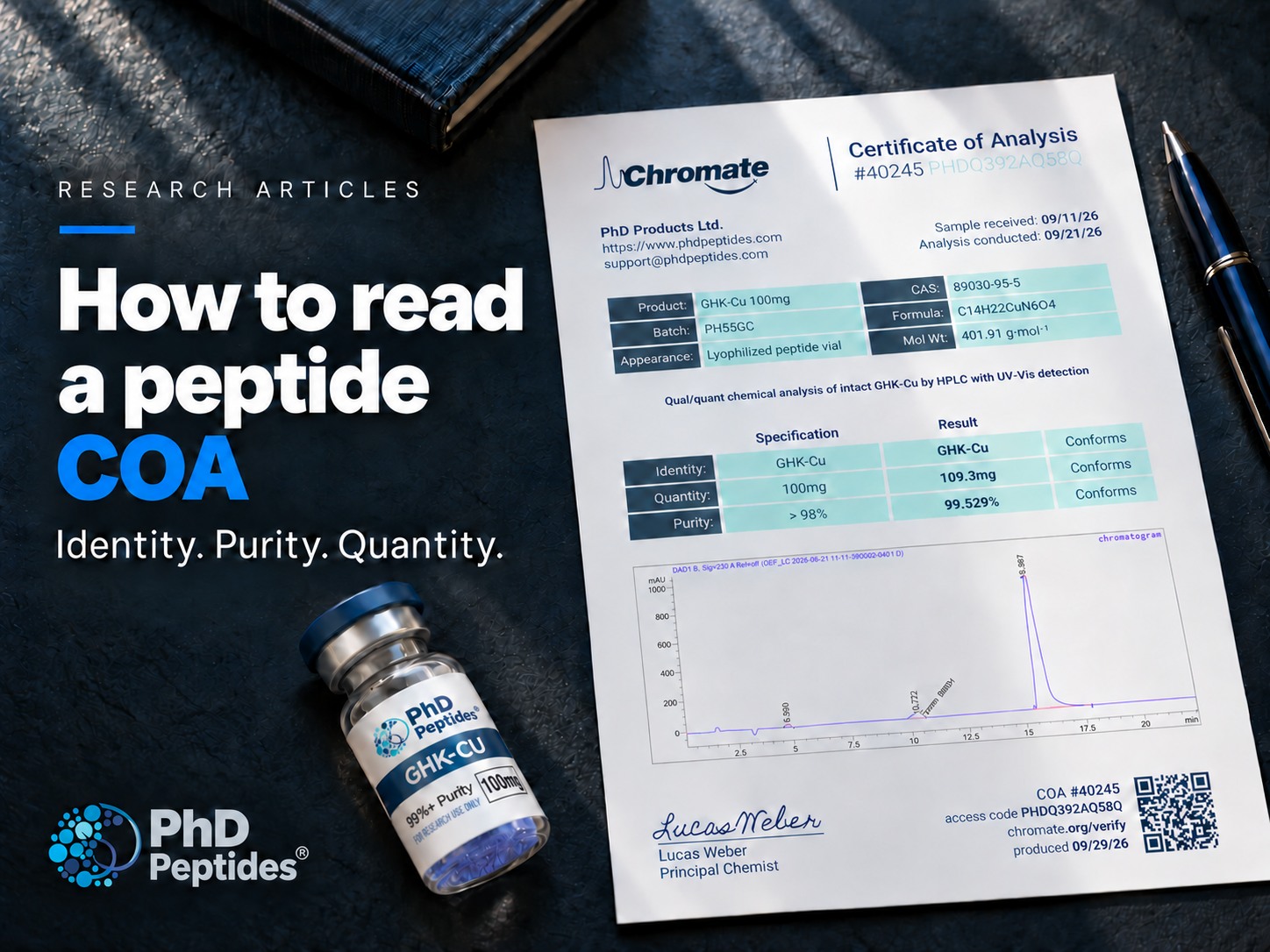
Begin with the top of the certificate, before looking for the largest purity number. A result needs an identity: a named laboratory, a report reference and a sample description that you can connect to the product.
| Look for | Why it helps |
|---|---|
| Laboratory name and report reference | Gives you an identifiable source for the result |
| Product and sample description | Connects the measurement to the material tested |
| Batch or lot code | Links the certificate to your supplied vial |
| Dates | Places sample receipt, analysis and reporting in context |
| Method, result and units | Shows what was measured and how it was expressed |
| Specification, if given | Lets you compare the result with the stated acceptance criterion |
If the laboratory provides a verification page or report lookup, use it. Match the report reference and sample details with the certificate you have opened. A verification link is most helpful when it leads to the specific report, so keep that link with your saved copy.
For an experiment record, a PDF or complete report is often more useful than a cropped screenshot. It preserves the footnotes, analytical descriptions and context that can be lost when only the result table is saved. OECD data-integrity guidance treats data as something managed throughout its life cycle, rather than only at the moment it is produced.[3]
Read the test name beside the number
Peptide reports often bring several measurements together. Identity concerns whether the material is consistent with the intended compound. Purity concerns the proportion assessed under the stated method. Quantity concerns the amount reported for the sample. Each is useful; together they provide a fuller description.
It helps to start with a sentence for each result. “This test supports the reported identity.” “This percentage was obtained by this purity method.” “This is the quantity reported for the submitted sample.” If you cannot complete the sentence, look for the method notes or ask a focused question.
Analytical methods are designed for a purpose. ICH Q2(R2), published by the FDA, discusses characteristics such as specificity, accuracy and precision when evaluating analytical procedures.[1] The practical lesson is to look for a method appropriate to the claim, so you can judge whether the method is appropriate to the question.
For example, an HPLC purity percentage and a quantity in milligrams should be read as separate results. Our guides to HPLC purity and purity versus quantity explain that distinction without requiring a chromatography background.
What does “traceable” mean here?
A batch code traces your material to its documents. Measurement traceability is a different concept: it connects a measurement result to a reference through a documented chain of calibrations, with uncertainty considered at each stage. NIST makes this distinction explicit.[2] If a report makes a measurement-traceability claim that matters to your work, ask what reference and calibration chain it uses.
A five-minute routine before you file the certificate
A consistent routine is more useful than a long checklist you never use. Try this sequence the next time you compare a research peptide or receive a new batch.
- Match the material. Compare the product name, nominal quantity and batch code with the vial or listing.
- Identify the report. Note the laboratory, reference and analysis date. Open the laboratory’s verification route if one is supplied.
- Read the actual results. Record identity, purity and quantity separately, including the methods and units provided.
- Relate them to your experiment. Check whether the reported properties answer the questions your protocol asks.
- Keep the connection. Save the report alongside the batch and your own sample identifier.
A submitted sample represents what was tested. How the result relates to a wider batch depends on the sampling arrangements. Recording this accurately is a normal part of using analytical evidence, and helps colleagues understand the basis of your material selection.
PhD Peptides provides a searchable COA Library so you can review published batch reports before ordering and return to the matching certificate when your material arrives. Pair that documentation with the product specifications to build a clear, practical record of what you are buying for your research.
Sources and further reading
- FDA / ICH Q2(R2): Validation of Analytical Procedures
- NIST: Metrological Traceability, Frequently Asked Questions
- OECD: GLP Data Integrity
For laboratory research and analytical use only. The sources explain scientific principles and do not imply endorsement of PhD Peptides. See our Research Use Only policy.
 How to Read a Peptide COA
 What does HPLC purity mean?