


What Is a Peptide? A Clear Guide for New Researchers
What Is a Peptide? A Clear Guide for New Researchers
Start with three letters, then see how sequence, molecular shape and batch information fit together.
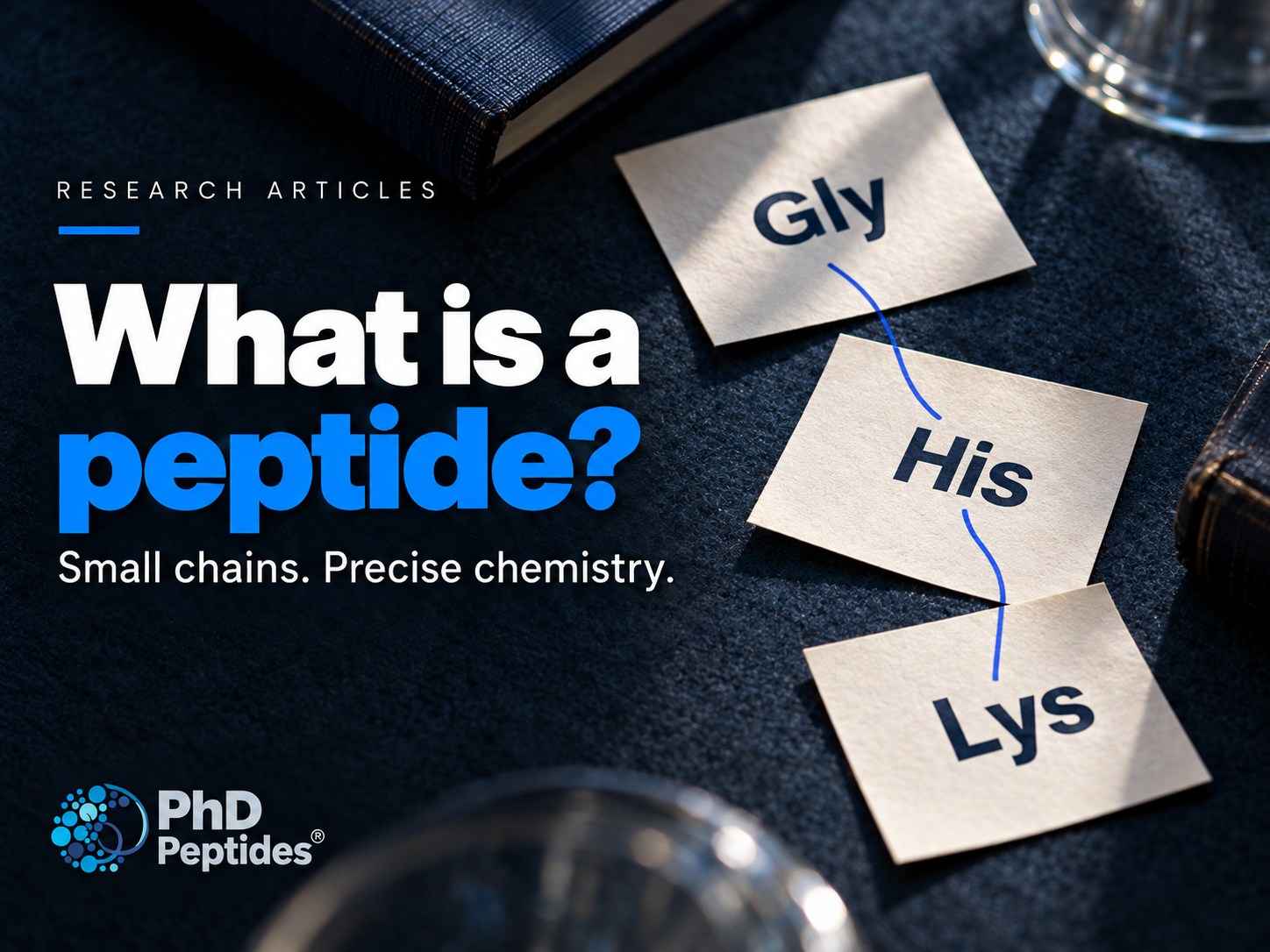
GHK looks like three letters. To a peptide chemist, it describes an ordered chain: glycine, histidine and lysine. Once you understand how that shorthand works, product specifications and research papers become much easier to follow.
A peptide is a molecule made from amino-acid units joined by peptide bonds. It can be a very short chain or a longer, chemically modified structure. What matters is not simply the number of units. Their order, the chemistry at the ends and any additional links help define the molecule.[1]
This introduction is written for someone starting laboratory research. You do not need to memorise twenty amino acids before choosing a sensible question to ask about a peptide. Begin with its sequence, then connect that sequence to the material and analytical report in front of you.
Amino acids are the units; peptide bonds are the joins
Many familiar amino acids share a common framework with an amino group, a carboxyl group and a side chain. The side chain is the part that differs: some are small, some bulky, some interact readily with water, and some can carry electrical charge under particular conditions.
A peptide bond is the covalent amide link connecting one unit to the next. In a standard linear peptide, the chain has an amino end, called the N-terminus, and a carboxyl end, called the C-terminus. A unit within the chain is usually called a residue.[2]
The word residue is easy to misread when you first encounter it. It does not mean an impurity left over from manufacture. It means the part of an amino acid incorporated into the peptide chain. A three-residue peptide contains three such units.
Useful vocabulary: amino acid describes the building block; residue describes that unit within the chain; sequence describes the order of those units.
Counting residues gives names such as dipeptide for two and tripeptide for three. Longer chains may be called polypeptides. The boundary between peptide and protein is not a single universally useful number; context, structure and established naming conventions also matter.[2]
Read the letters from the correct end
Peptide sequences are conventionally written from N-terminus to C-terminus. Researchers use either three-letter amino-acid abbreviations, such as Gly, or compact one-letter symbols, such as G. The symbols let a complete sequence fit comfortably into a specification or figure.[3]
Read the GHK sequence
N-terminus
Read downwards ↓
- Gly · GGlycine
- His · HHistidine
- Lys · KLysine
C-terminus
Sequence order only, not a molecular structure.
Order matters. GHK and KHG contain the same three types of residue in different arrangements. A list of ingredients would not distinguish them, but a sequence does. This is why amino-acid composition and amino-acid sequence are related pieces of information rather than interchangeable descriptions.
You do not have to decode an entire long sequence at a glance. Read it in small groups, check unfamiliar abbreviations against a reliable table and look for notes attached to either end. Those notes may be as important as the letters.
A peptide is more than a flat string of letters
The sequence is a starting point for understanding behaviour in an experiment. In three dimensions, parts of a chain can interact with each other and with the surrounding solution. A peptide may adopt particular shapes, remain flexible or associate with other molecules.
Chemists can also modify peptides. Examples include changing the chemical groups at the ends, attaching a label, or introducing a link that constrains the chain. These changes can alter properties, so a modified peptide should be identified with its modification rather than only the parent sequence.[4]
Disulfide bonds provide a good example of extra structural information. They connect suitable cysteine side chains. Where several cysteines are present, the pairing matters: the same list of residues does not, on its own, describe which connections have formed.
In an original study published in Nature, Bhardwaj and colleagues designed constrained peptides and compared structural measurements with the designs. The study illustrates why scientists describe sequence and architecture together when they want to understand a molecule. Its results concern the studied peptides, not every product sold as a research peptide.[5]
A familiar catalogue name can also refer to a complex. GHK-Cu contains the GHK peptide associated with copper. For practical documentation, use the full compound name and the stated molecular form, not just the three-letter peptide sequence.
Five details that make a product page easier to read
When you browse a research peptide, separate the description of the molecule from measurements of the supplied batch. That distinction gives each line of the specification a clear job.
| Entry | Question it answers |
|---|---|
| Name and molecular form | Which compound is being described? |
| Sequence and modifications | How is the peptide built? |
| Molecular mass | What is the mass of the defined molecule? |
| Purity result | What proportion was attributed to the target by the stated method? |
| Quantity result | What amount was reported for the sample, and on what basis? |
For example, the milligrams printed on a vial refer to an amount of material. Molecular mass describes an individual molecular species. A purity percentage is another measurement again. Reading them as separate answers prevents a lot of early confusion.
The PhD Peptides COA Library is a useful place to practise. Choose a report, match its product and batch to the relevant page, then find the identity, method and results. Our worked COA guide walks through a real GHK-Cu example.
Start a research question with a clearly defined material
Before comparing results between papers, check that the authors studied the same form of the peptide. A label, terminal modification, different sequence or metal complex can make two similarly named materials distinct experimental inputs.
Then look at the question the experiment asks. A study measuring chemical stability, for example, needs to define the storage conditions and analytical method. A binding experiment needs to describe its target and controls. The material is one part of a complete method.
When choosing from the PhD Peptides research peptide range, use the specification and published batch report to build that initial record. With the identity clear, you can spend more time on the experiment and less time untangling what the product name meant.
A few useful answers
Is an amino acid the same as a peptide?
No. An amino acid is a building block. A peptide contains amino-acid units linked by peptide bonds.
Does a longer peptide automatically mean a more useful research material?
No. The appropriate material depends on the experimental question. Length is one structural detail, alongside sequence, modifications and molecular form.
Can two peptides have the same molecular mass but different sequences?
Yes. Reordering the same residues can preserve the composition and mass while changing the sequence. Molecular mass alone does not establish the complete structure.
Sources and further reading
- IUPAC Gold Book: Peptides
- IUPAC / IUBMB: Peptide definitions and nomenclature, sections 3AA-11 to 3AA-13
- IUPAC / IUBMB: Three-letter amino-acid symbols, sections 3AA-14 to 3AA-16
- Thermo Fisher Scientific: Peptide design principles and modifications
- Bhardwaj et al. (2016): Accurate de novo design of hyperstable constrained peptides
 Sequence, Mass and CAS Numbers
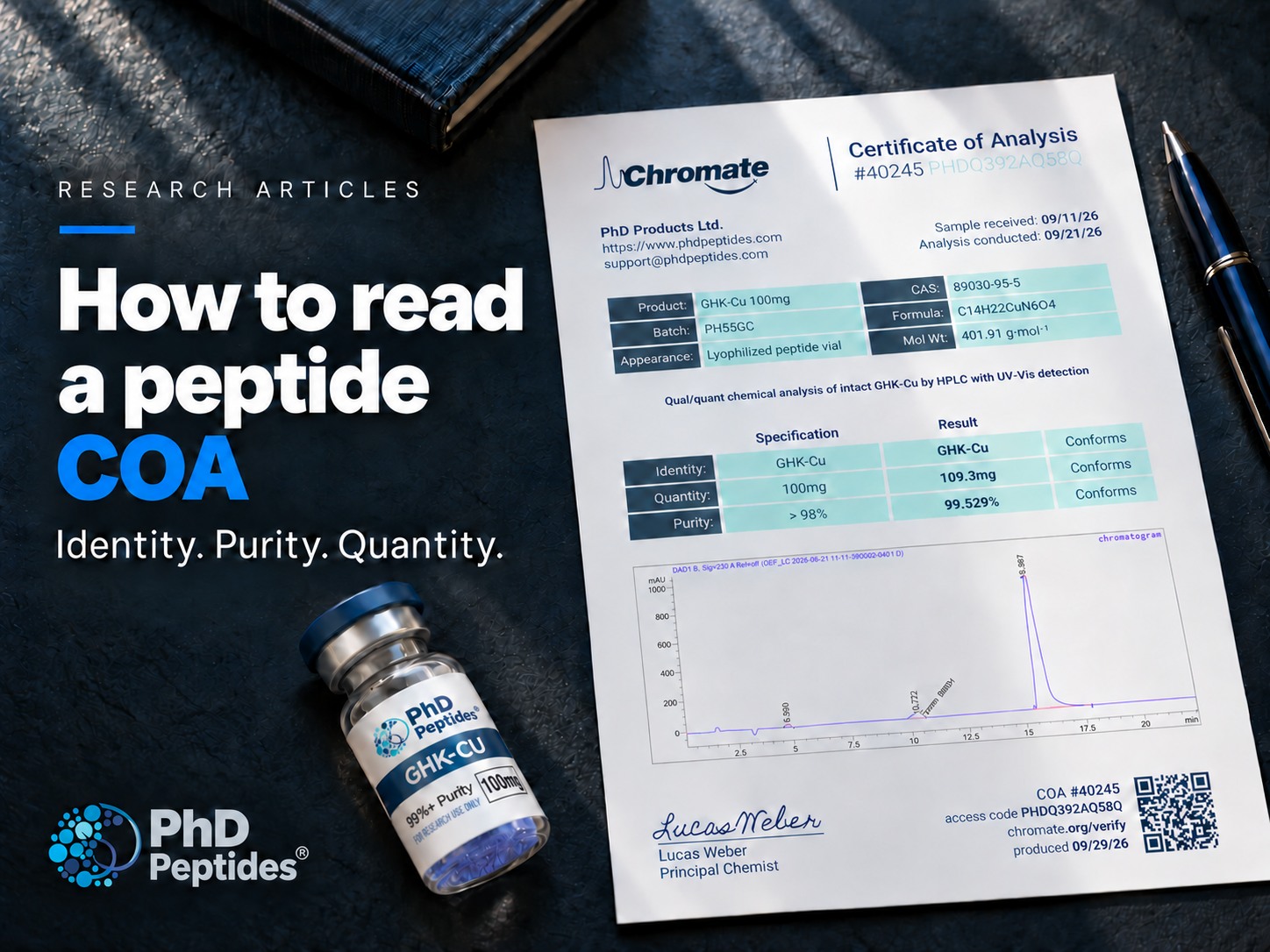 How to Read a Peptide COA