


What Is GHK-Cu? The Science Behind the Blue Copper Peptide
What Is GHK-Cu? The Science Behind the Blue Copper Peptide
Understand the three-amino-acid sequence, copper chemistry and batch documentation behind this distinctive research peptide.
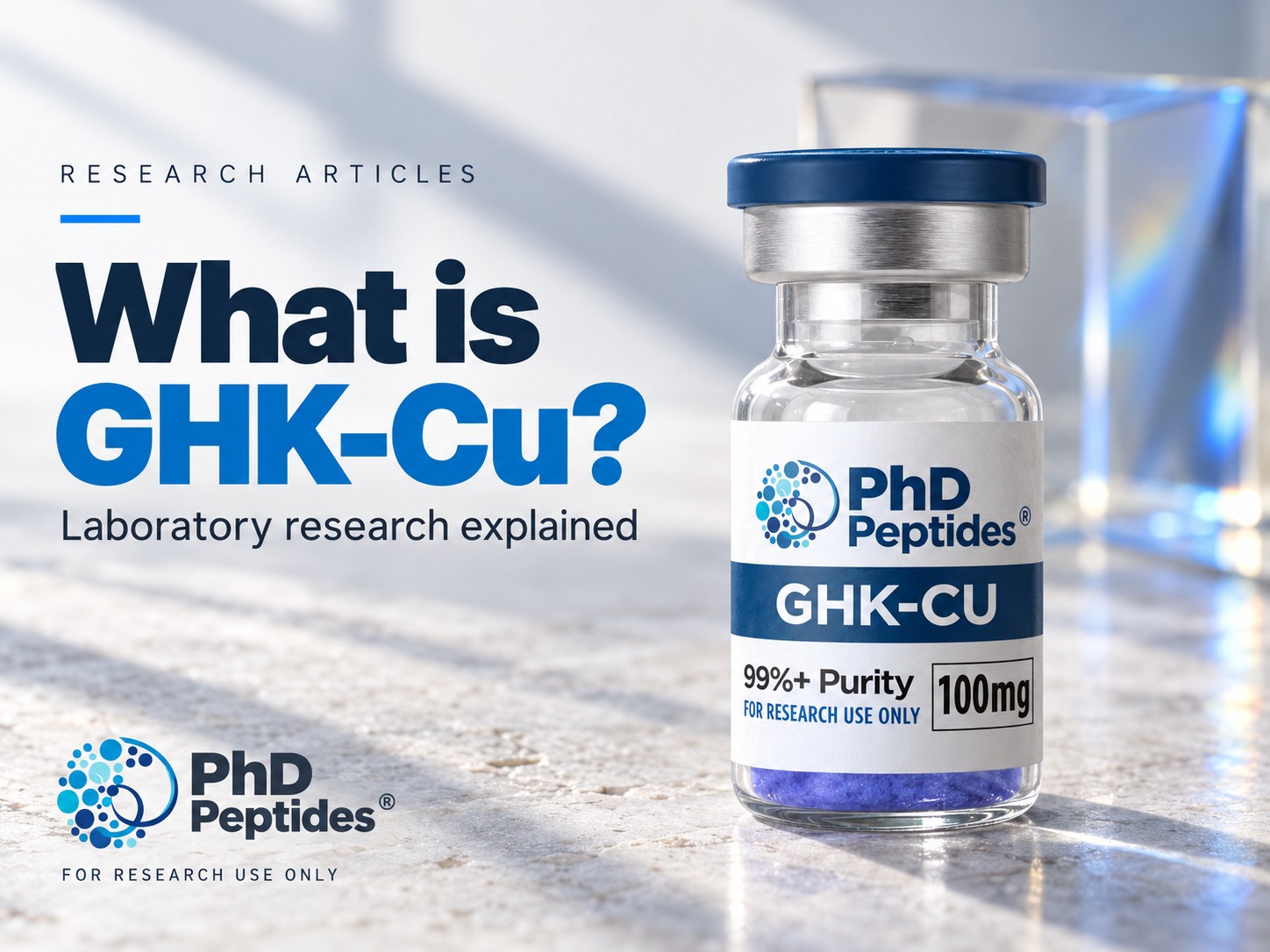
Open a line-up of research peptide photographs and GHK-Cu is easy to spot. Its blue powder looks quite different from the white or off-white material in many other vials. That colour is an inviting introduction to its chemistry: a short peptide holding a copper ion.
For laboratory and analytical research only. Not for human or veterinary use. PhD Peptides supplies research materials for qualified researchers, not products for personal, cosmetic or clinical use.
This guide explains what GHK-Cu is, why copper changes its appearance and which details make a batch useful to a laboratory. We also show how to connect those ideas to the PhD Peptides GHK-Cu 100mg product and its current certificate.
What does GHK-Cu stand for?
GHK is the one-letter shorthand for three amino acids: glycine, histidine and lysine. Joined in that order, they form a tripeptide. Cu is the chemical symbol for copper. In GHK-Cu, the peptide forms a coordination complex with copper(II), often written Cu(II).[1]
A coordination complex forms when suitable atoms around a metal ion donate electron pairs to it. For GHK, nitrogen-containing groups in the peptide provide important binding sites. This is a more specific arrangement than simply having a peptide and a copper salt in the same container.
Think of the name as two pieces of information: the peptide sequence and the metal associated with it. Both matter when searching papers or comparing specifications. A study of uncomplexed GHK is not automatically a study of GHK-Cu.
The distinction becomes useful immediately in a notebook. Record “GHK-Cu” rather than “copper peptide”, then add the batch and report reference. The precise name gives someone else a much better starting point when they return to your work.
Why is GHK-Cu blue?
Colour comes from the way a material interacts with visible light. Copper(II) has electrons whose energy levels are affected by the atoms surrounding the ion. The resulting complex absorbs some wavelengths more strongly than others. The light reaching our eyes gives the material its characteristic blue appearance.[2][3]
This also explains why copper chemistry attracts spectroscopists. An instrument can record an absorption spectrum across wavelengths, providing information beyond the impression of colour. Published GHK-copper studies have used UV-visible spectroscopy alongside techniques such as potentiometry and electron paramagnetic resonance to investigate complex formation.[2]
For a product photograph, blue makes GHK-Cu distinctive. For a laboratory record, appearance is one observation alongside analytical results. Lighting, the amount of powder, the glass and the way a dried cake is distributed can all influence how a vial looks.
Use the colour to recognise the material’s appearance, and the certificate to understand the batch. A deeper blue is not a direct measurement of higher purity or greater quantity.
The PhD Peptides product is supplied as a blue lyophilised powder. A smooth-looking area at the bottom of a vial photograph should not be read as a liquid product. Freeze-drying can leave a cake or powder with a range of surface textures.
A small complex with useful research questions
GHK-Cu provides a manageable way to investigate peptide-metal chemistry. Researchers can examine how a peptide coordinates copper, how experimental conditions affect the species present, or how a chosen analytical method distinguishes the complex from other components.
Conditions deserve attention. In a published solution study, researchers examined copper, GHK and an additional ligand using several complementary methods. Their work illustrates how pH, composition and competing binding partners influence the system being measured.[1] The useful lesson for a new researcher is to read the experimental conditions together with the result.
When you read a GHK-Cu paper, start with three questions:
- What material was studied? Check the sequence, metal complex and source.
- What was around it? Note the solvent, buffer, pH and other compounds in the experimental system.
- What was measured? An absorption spectrum, chromatographic result and molecular model each answer a different question.
These details let you compare studies on a chemical basis. They also help you choose which method belongs in your own approved laboratory work, without treating a paper’s conclusion as a general property of every vial.
How to read a GHK-Cu specification
Start with identity, then look at purity, quantity and the report’s methods. The fields work together, but they should stay separate in your notes.
| Detail | What to look for |
|---|---|
| Material identity | The named GHK-Cu complex and the identification result stated on the report |
| Purity | The reported percentage, method and specification |
| Quantity | A separate result in milligrams, where provided |
| Batch code | The connection between vial, product information and certificate |
| Storage | The instructions for the supplied material and its packaging |
HPLC separates sample components before a detector records their responses. An area percentage describes the responses included in that calculation; it is not interchangeable with a mass measurement.[5] Peptide quality-control guidance likewise distinguishes chromatographic purity from peptide content and other contributions to dried material.[4]
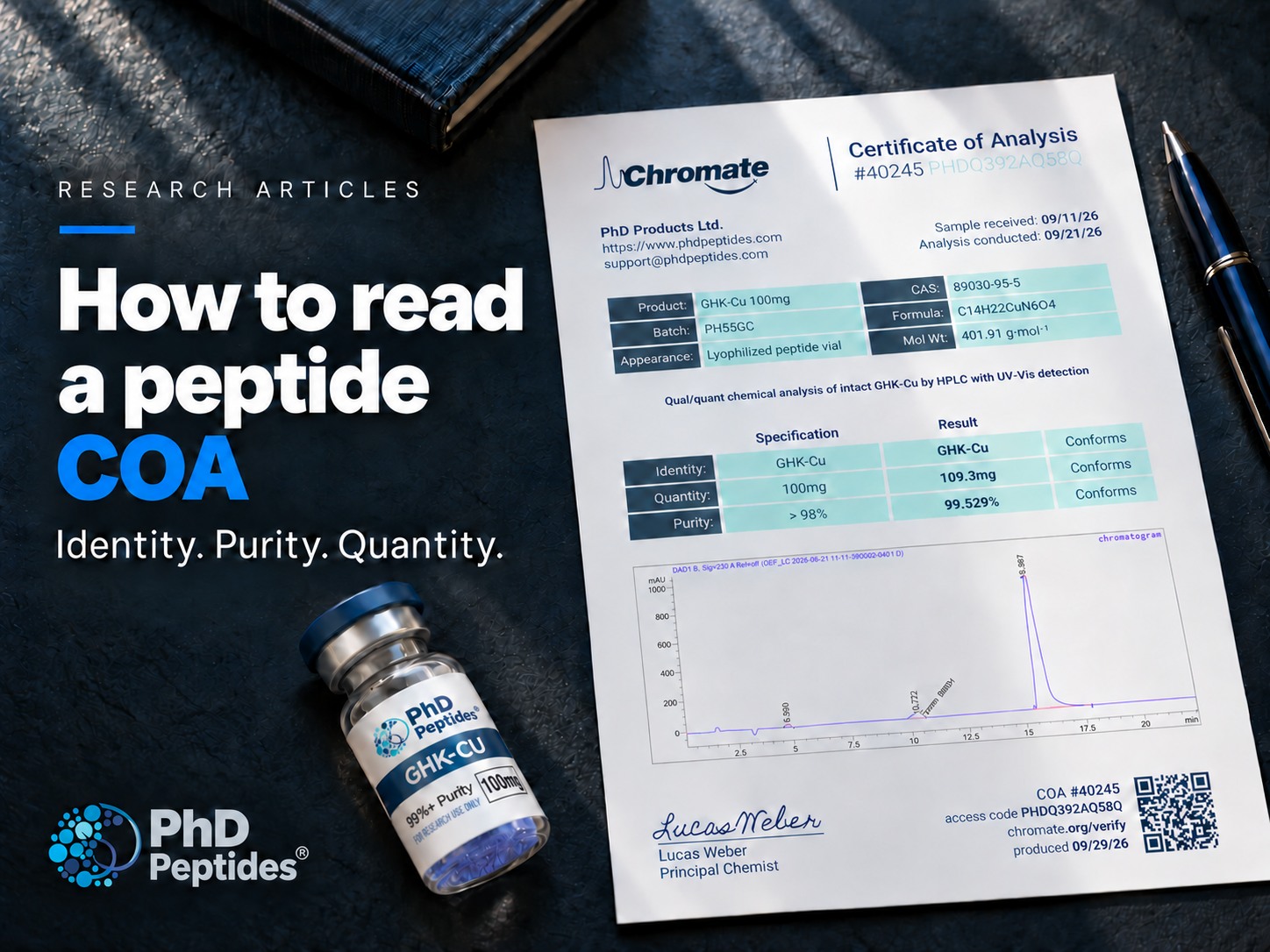
For a worked example, our COA guide uses a GHK-Cu report to explain these fields side by side. The purity versus quantity guide takes that distinction further.
Connect the chemistry to your PhD Peptides batch
The GHK-Cu 100mg page brings the product specification and current batch certificate together. Check the current report when planning your order, then match it with the batch code on arrival. This keeps your research record tied to the material actually received.
Save the certificate with the experiment record and note the date the vial was received and opened. Follow the product’s storage instructions and your laboratory’s handling procedures. For material moved between storage and the work area, clear labelling and a simple record make later comparisons easier.
You can also find the published report through the PhD Peptides COA Library. Understanding the name, colour and analytical fields turns that report into something more useful than an attachment: it becomes a reference you can carry through the work.
GHK-Cu research questions
Is GHK the same as GHK-Cu?
No. GHK names the glycine-histidine-lysine peptide. GHK-Cu specifies its copper complex. Use the exact form described by the study or product documentation.
Does blue colour prove GHK-Cu purity?
No. Appearance is useful to record, but purity and quantity require the appropriate analytical results. Compare the method and batch certificate, not the shade of a photograph.
Is PhD Peptides GHK-Cu intended for human use?
No. It is a research peptide for laboratory and analytical work only, not for human or veterinary use, consumption or cosmetic application.
Sources and further reading
- Original research (2020): Ternary Cu(II) Complex with GHK Peptide and Cis-Urocanic Acid
- Original research (2001): Copper complexes of glycyl-histidyl-lysine and two of its synthetic analogues
- Shimadzu: Absorption spectroscopy, electronic transitions and observed colour
- Bachem: Quality Control of Amino Acids & Peptides
- Shimadzu: What is HPLC?
For laboratory and analytical research only. Not for human or veterinary use. Scientific references explain the chemistry and analytical principles; they do not imply approval or endorsement of PhD Peptides. Read our Research Use Only policy.
 How to Read a Peptide COA
 Peptide Purity vs Quantity: How Much Is in the Vial?