


COA, SDS or COSHH: Which Document Do You Need?
COA, SDS or COSHH: Which Document Do You Need?
Three documents, three purposes. A practical guide to the paperwork that supports a well-organised research laboratory.
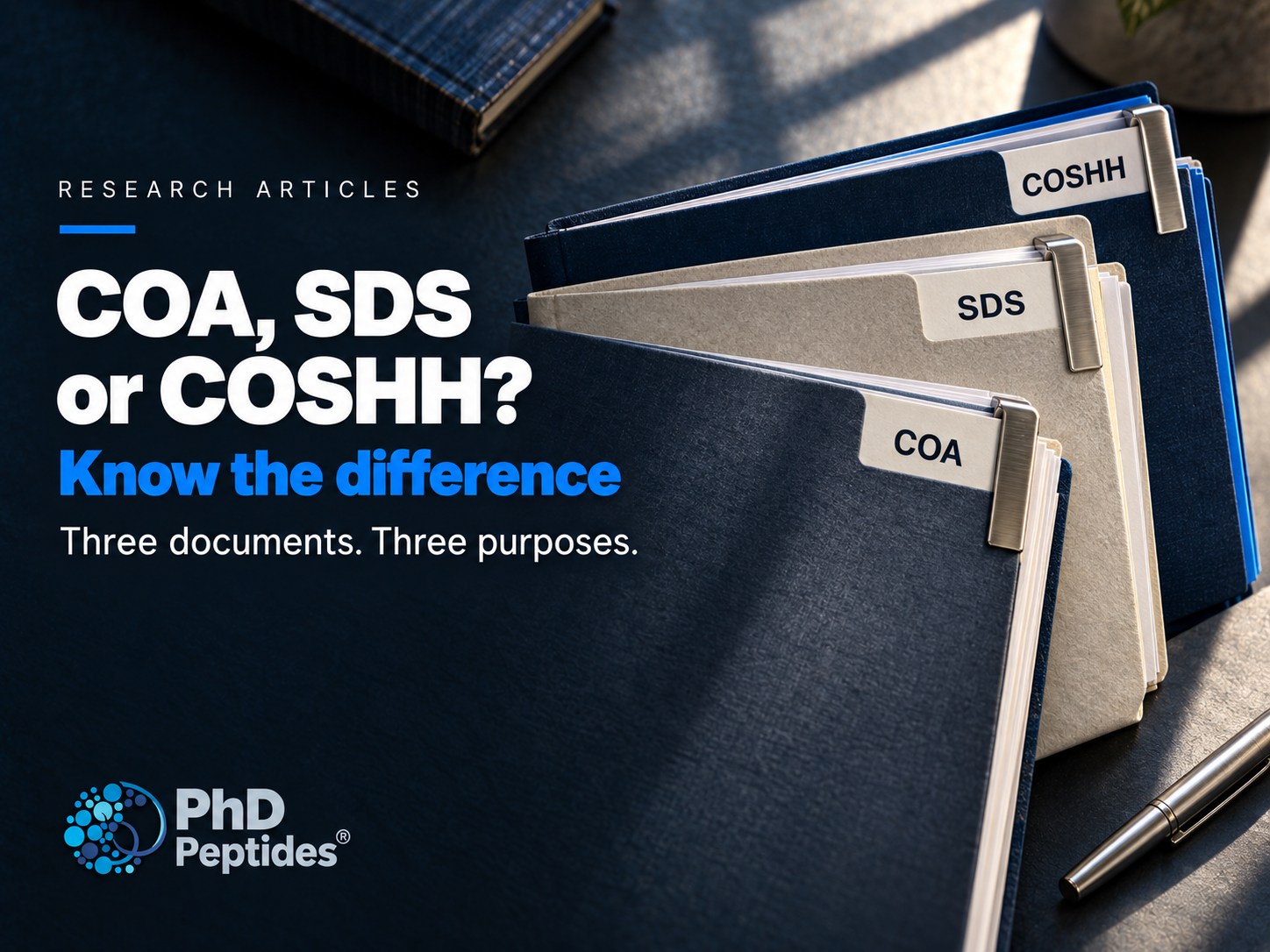
A certificate of analysis, a safety data sheet and a COSHH assessment can all sit in the same research folder. They are there for different reasons. Knowing which document answers which question makes ordering, receiving and working with research materials much more straightforward.
Start with three simple ideas: the COA describes analytical findings, the SDS provides chemical safety information, and the COSHH assessment applies relevant information to the work being carried out. Together, they help connect a documented material with a well-planned laboratory task.
COA, SDS and COSHH: the difference at a glance
| Document | Main purpose | Typical question |
|---|---|---|
| Certificate of Analysis, or COA | Reports analytical results for an identified sample or batch | What identity, purity or quantity result was reported? |
| Safety Data Sheet, or SDS | Communicates chemical hazards and relevant safety information | What handling, storage and emergency information should be considered? |
| COSHH assessment | Evaluates and controls exposure risks in a particular workplace activity | How will our team carry out this task with appropriate controls? |
The distinctions are useful even when the documents contain overlapping details. A chemical name may appear on all three, but that does not make them interchangeable. Each belongs to a different part of the decision.
This guide focuses on laboratory documentation and HSE guidance relevant to Great Britain. Northern Ireland and other jurisdictions have their own regulatory arrangements, so use the requirements and professional guidance appropriate to your laboratory’s location.
What does a peptide COA tell you?
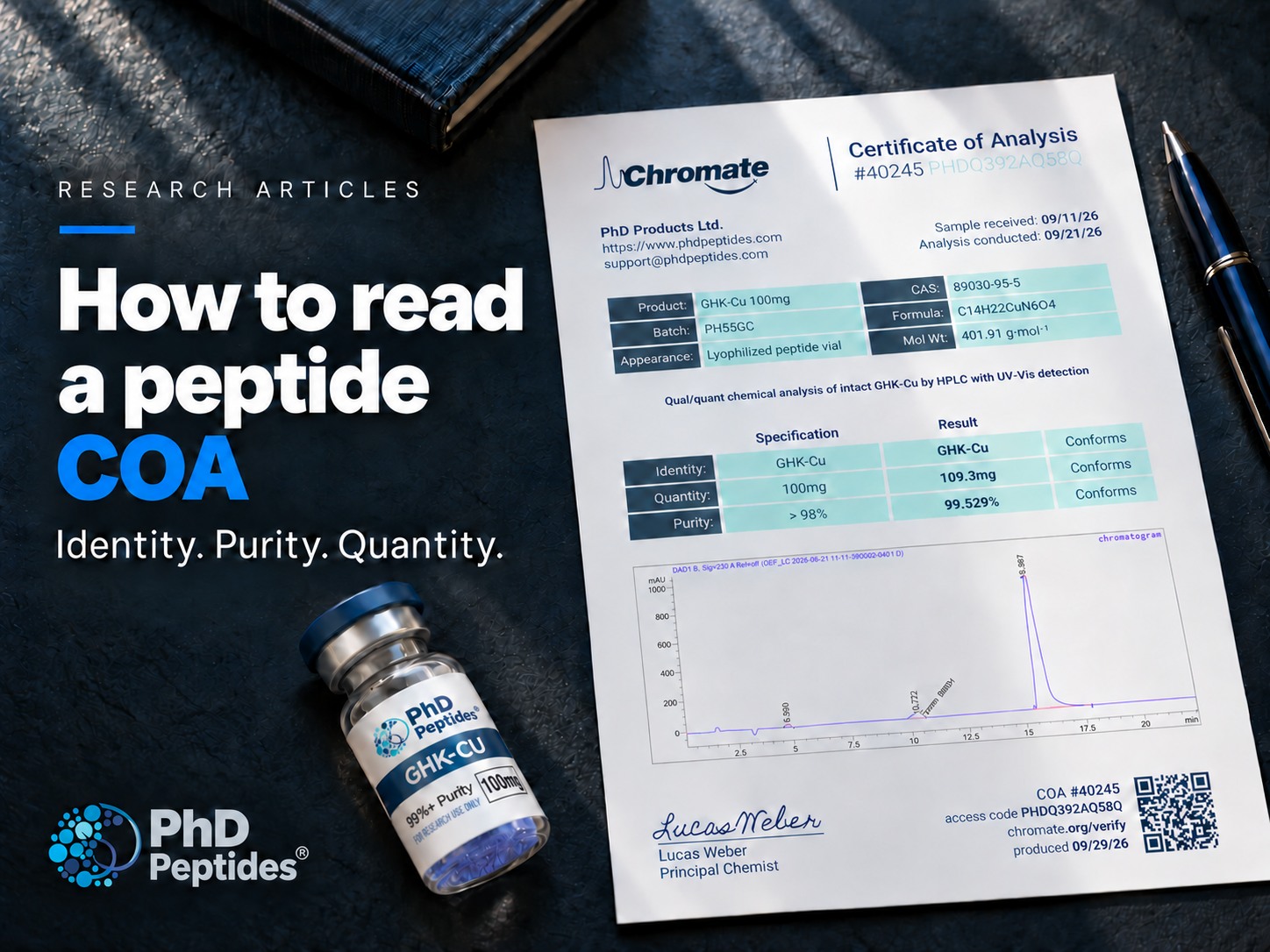
A COA normally identifies the material and records the tests performed, the specification used and the reported results. For research peptides, that may include identity, chromatographic purity and a quantity or content measurement. These are separate analytical questions, even when they appear in adjacent rows.[1]
The batch code is the practical link. Match it to the vial and retain the report with the relevant product specification. A report for a previous batch can provide background, but the matching document gives you the most directly relevant record for the material received.
Read the method and units alongside the result. A chromatographic purity percentage and an amount in milligrams are not alternative ways of expressing the same property. Our COA reading guide walks through a real GHK-Cu example.
Use the COA for material selection and traceability. It helps you document what was measured. Use the safety information and workplace assessment for decisions about how the task will be carried out.
For a new researcher, keeping those two purposes separate is particularly helpful. You can review whether the analytical information meets your experimental needs while the laboratory’s responsible person reviews the working arrangements.
How does an SDS help?
An SDS brings together information about a chemical’s hazards, handling, storage, exposure controls and emergency measures. HSE explains that these documents support workplace risk assessment; the SDS itself is not the assessment.[2]
SDS requirements depend on the substance or mixture and the applicable supply rules. Do not assume that every product needs an identical set of documents simply because it is sold for research. Equally, an absence of a hazard symbol is not a complete assessment of every possible laboratory activity.
Read it with your task in mind
The standard SDS format has 16 sections. Identification and hazards appear near the beginning; handling and storage are in section 7, exposure controls and personal protection in section 8, and stability and reactivity in section 10. Disposal considerations appear in section 13. The section headings provide a practical route through the document.[3]
First confirm that the product and supplier details match. Then check the revision information and look at the sections relevant to your planned work. If you will use a solvent or another reagent with the peptide, that material needs its own place in the review.
A useful request to a supplier is specific: include the product name, form, batch where relevant, and the information your laboratory needs. This is more productive than asking for a generic “safety certificate”, which can mean different things to different people.
What does a COSHH assessment add?
COSHH stands for the Control of Substances Hazardous to Health. An assessment considers how people could be exposed during the actual work and what controls are needed. The same substance can present different exposure opportunities in different activities.
For example, receiving a sealed vial, opening dried material and cleaning up after an analytical procedure are different tasks. The assessment considers the material’s form, the work, who may be affected and the measures used to prevent or adequately control exposure. HSE’s guidance starts with identifying hazards and evaluating risks, then selecting appropriate controls.[4]
That is why a downloaded SDS cannot know the complete answer for your laboratory. It cannot describe your equipment, work area, staff training or the other substances in a procedure. The workplace assessment joins those details to the product information.
Make the record easy for colleagues to use
HSE does not prescribe one universal COSHH form. What matters is covering the task, the potential harm, the controls and how those controls will be used and checked. The person doing the assessment needs suitable knowledge, skills and experience.[5]
A clear record helps the next person understand the work without reconstructing the reasoning from several separate files. Keep links to the current safety information and make the relevant procedures accessible to the people carrying out the task.
A practical workflow for a new research material
Imagine a peptide arrives for an analytical project. The useful first step is to bring its identifying information together, then connect it to the planned work. A short intake checklist can keep this consistent across different members of the team.
- Identify the material. Record the product, batch, form and date received.
- Match the analytical report. Save the relevant COA with the product specification.
- Gather safety information. Use the applicable SDS and handling information for the material and associated reagents.
- Review the task. Confirm that the laboratory’s assessment and procedures cover the intended work.
- Keep the connection. Link working samples and experiment records back to the original material.
At PhD Peptides, the COA Library makes published batch reports easier to find and retain. Use the batch code on the vial when searching, and keep a local copy with your project records. If your laboratory needs further product information, include that code in your enquiry so the request can be addressed accurately.
The benefit of this approach is practical: fewer disconnected documents, clearer handovers and a better record of why a particular material was selected. The COA supports the analytical story, the SDS supports the safety review, and the assessment makes that review relevant to the actual task.
Sources and further reading
- Bachem, Quality Control of Amino Acids & Peptides: A Guide.
- HSE, Safety Data Sheets: Chemical Classification and Supply.
- HSENI, REACH Safety Data Sheets: Standard Section Headings.
- HSE, How to Carry Out a COSHH Risk Assessment.
- HSE, COSHH Frequently Asked Questions.
General laboratory guidance, reviewed against the linked sources on 16 October 2026. It does not replace a competent workplace assessment or advice on the requirements applying to your organisation and location. Products are for laboratory research and analytical use only.
 How to Read a Peptide COA
 Every batch has a story